 Closure of Cloud Forest on 26 Oct 2026
Cloud Forest will be closed on 26 Oct 2026 for Maintenance.
Traffic Advisory for Garmin Run Marathon Series 2026 Singapore on Sun, 25 Oct 2026
Please note the following carpark arrangements to facilitate the Garmin Run Marathon Series 2026 Singapore:
- Satay by the Bay Carpark: Closed from 12.01am to 8.00am.
- Main Entrance Basement Carpark: Opens earlier at 3.30am.
- Bayfront Plaza and The Meadow Carparks: Remain accessible throughout the event.
Traffic delays may be expected at the Gardens' carparks due to the Garmin Run Marathon Series 2026 Singapore.
For more details, click here for more details.
Advisory for use of tripods at Disney Garden of Wonder at Floral Fantasy
For a better visiting experience and facilitate crowd movement, we seek your kind understanding that usage of tripods and camera stands will not be permitted in Floral Fantasy.
Bay South–Bay East Bridge Construction from 4 May 2026
To facilitate the construction of the bridge linking Bay South Garden and Bay East Garden, there will be no access for cyclists along the Waterfront Promenade from 4 May 2026. During the construction of the bridge, cyclists heading towards Marina Barrage are advised to take an alternative route around the perimeter of Bay South Garden. Pedestrians may still access the Waterfront Promenade, with a slight diversion to their route.
Click here to download the diversion map.

{{ suggestion.item }}
{{ noOfResults }} results found for "{{ submittedQuery }}"
Filter by
({{ currentFilters.length }})

Showing {{ searchResults.length }} out of {{ noOfResults }}
{{ result.category.label }}
We’re sorry. 0 results found for "{{ submittedQuery }}"
Try doing these:
- Check your spelling
- Try more general words
- Try different keywords
Oriental Magpie-Robin
Throughout the Gardens
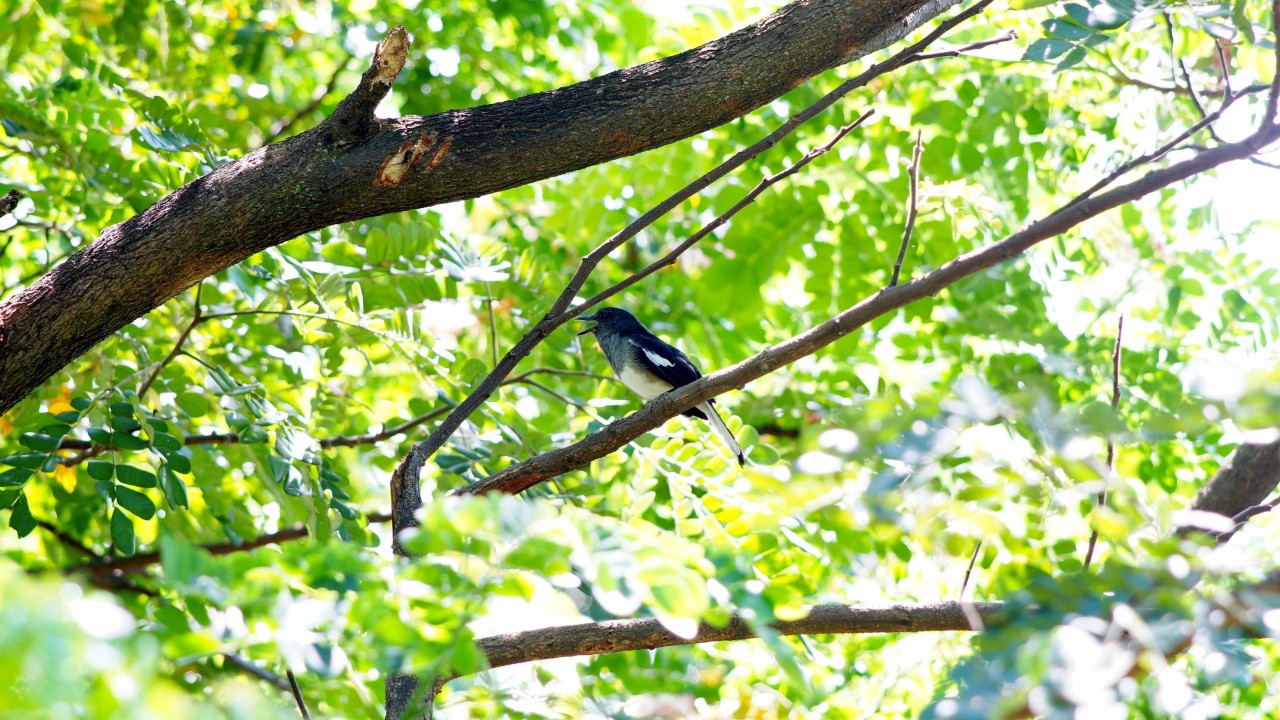
A native songbird in Singapore, the Oriental Magpie-Robin (Copsychus saularis) used to be a common sight until it experienced a severe population decline from the 1970s, driven by a combination of illegal poaching, habitat loss and competition from introduced bird species. To combat the severe population decline, a reintroduction programme was initiated in the early 1980s, which successfully reversed the potential population collapse.
Fortunately, the Oriental Magpie-Robin can be spotted at various parts of Gardens by the Bay, often seen hopping on the ground or perched with their long tails held upright. Males have glossy black heads, throats and backs with white underparts, often with a metallic sheen. Females are smaller in size, with dark grey plumage. Despite their small size, males are highly territorial, defending their turf by singing loudly and chasing away intruders.
In Singapore, Oriental Magpie-Robins breed earlier in the year, typically from January to July, peaking in April and May. They are secondary cavity nesters; instead of excavating their own holes, they utilise existing natural cavities or holes in artificial structures. Both male and female share parenting duties, with the female being the nest builder, creating a shallow cup-shaped nest made from grass, dried leaves, twigs, etc. The female usually lays a clutch of 3 to 6 eggs, which are pale blue-green with brown speckles. Both parents work together to feed their chicks after they have hatched, often visiting the nest every 5 to 10 minutes throughout the day! This intensive feeding period lasts for about 3 to 4 weeks, including both the time in the nest and the duration of care after they learn to fly.
Despite its recovery, the Oriental Magpie-Robin remains a nationally threatened species in Singapore and faces ongoing threats from poaching and habitat loss. The high demand from countries in Southeast Asia continues to drive the illegal trade of this species. Hence, close monitoring of its local population, together with a protection plan, would be necessary to ensure its continuity.
You may also be
interested in
 Back To Top