 Advisory for use of tripods at Disney Garden of Wonder at Floral Fantasy
For a better visiting experience and facilitate crowd movement, we seek your kind understanding that usage of tripods and camera stands will not be permitted in Floral Fantasy.
Bay South–Bay East Bridge Construction from 4 May 2026
To facilitate the construction of the bridge linking Bay South Garden and Bay East Garden, there will be no access for cyclists along the Waterfront Promenade from 4 May 2026. During the construction of the bridge, cyclists heading towards Marina Barrage are advised to take an alternative route around the perimeter of Bay South Garden. Pedestrians may still access the Waterfront Promenade, with a slight diversion to their route.
Click here to download the diversion map.

{{ suggestion.item }}
{{ noOfResults }} results found for "{{ submittedQuery }}"
Filter by
({{ currentFilters.length }})

Showing {{ searchResults.length }} out of {{ noOfResults }}
{{ result.category.label }}
We’re sorry. 0 results found for "{{ submittedQuery }}"
Try doing these:
- Check your spelling
- Try more general words
- Try different keywords
Wisteria (Wisteria species and cultivars)
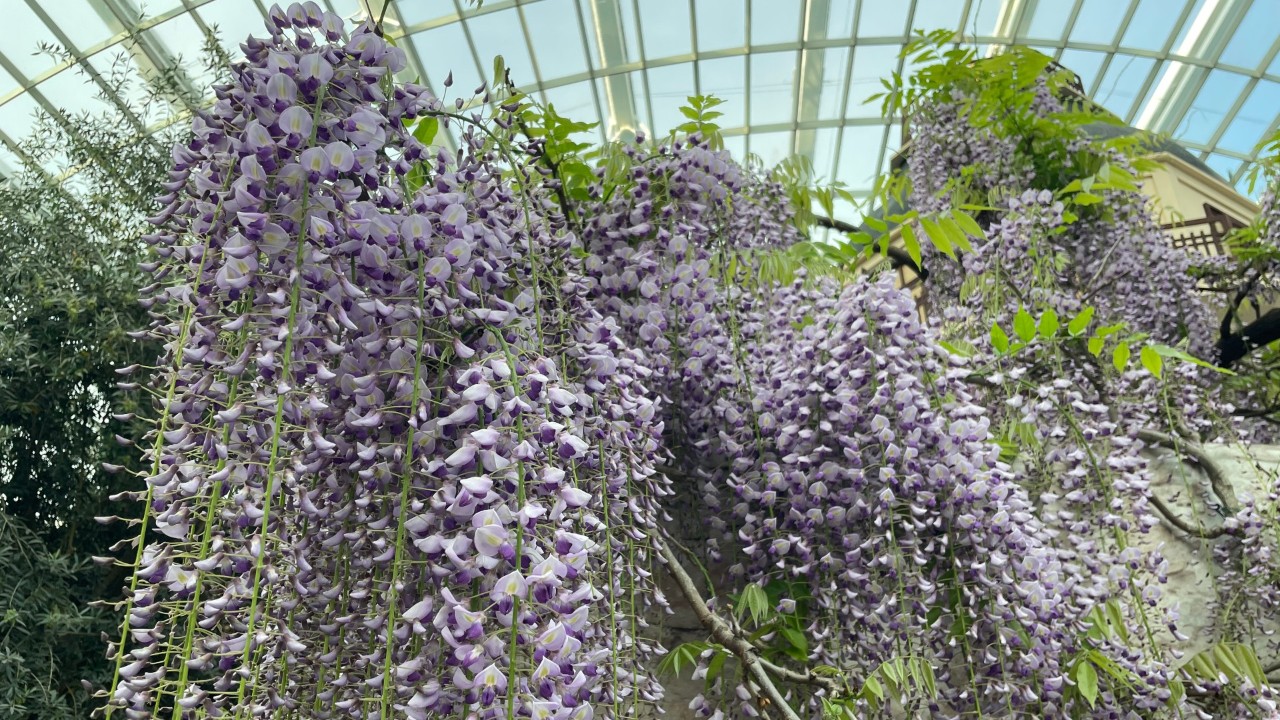
Wisterias in Singapore? You bet! Stealing the spotlight from our blue beauties, the hydrangeas, is this magnificent, lavender-flowered wisteria (Wisteria spp. and cultivars)!
As you might guess from its pea-like flowers, the four to six species in the Wisteria genus are members of the pea family (Fabaceae)! These include three East Asian species, native to central and eastern China, central and southern Japan, and possibly Korea, as well as an American species native to the eastern United States.
The most famous among these are the iconic Japanese wisteria (W. floribunda) famed for its flower clusters (racemes) from 30cm to 2m in length, and the Chinese wisteria (W. sinensis), with shorter, fuller blue-violet racemes up to 30cm in length. Also grown ornamentally is the silky wisteria (W. brachybotrys) - a lesser-known Japanese species – which usually only produces flower clusters of 10 to 15cm in length.
Our unique, unknown Japanese cultivar is specially selected to produce flower clusters that reach over 70cm long! It has flower anatomy and development characteristics strongly resembling W. floribunda, and may be a cultivar or hybrid of that species.
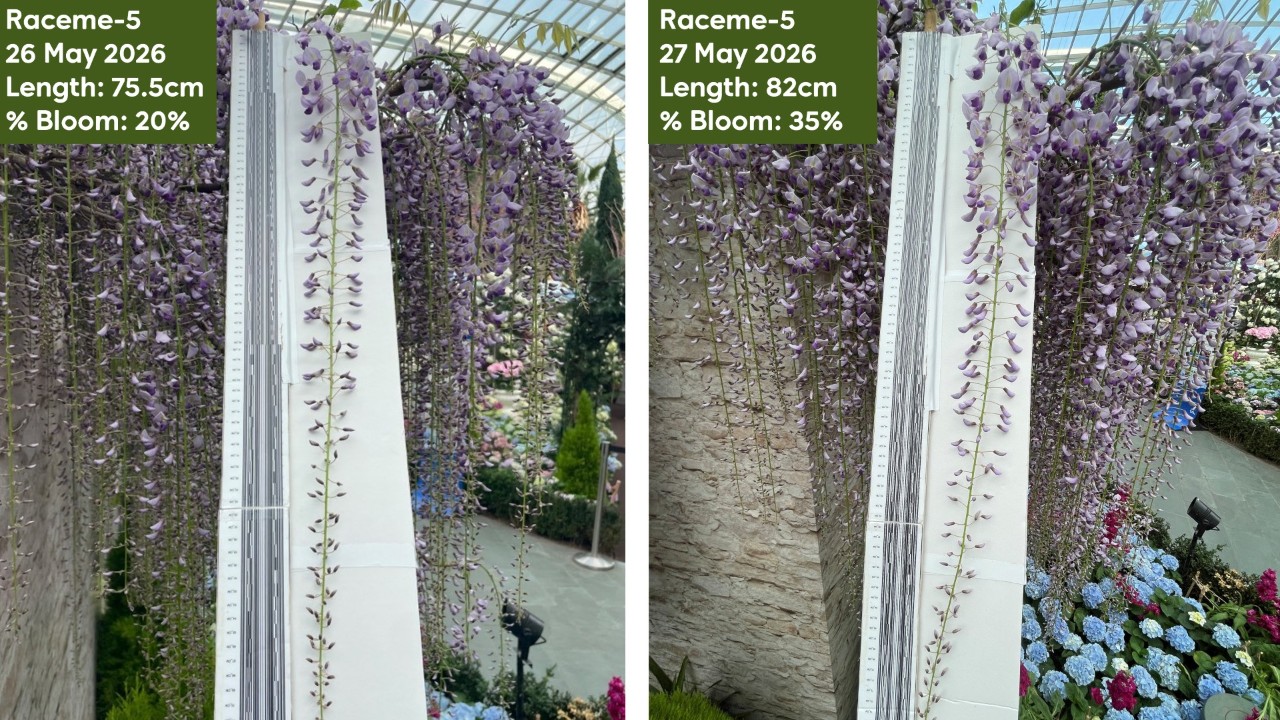 Photo montage showing the same raceme over two consecutive days. Spot QR code tags in the display? These help our senior researcher and author of this article keep track of and collect flowering data on specific inflorescences to see how long their display duration lasts.
Did you know wisteria plants are not trees but stout, woody vines (lianas), similar to grapevines? This one has been specially trained for us for seven years by an experienced grower in Japan, using bonsai techniques to produce plants with short, twisted trunks and sturdy branches dripping with hundreds of beautiful purple flower clusters or inflorescences. Unlike many other plants that bear their flower stalks pointing upwards, these woody vines have pendulous, downward-hanging inflorescences. In their native ranges, wisteria are insect pollinated – mostly by carpenter or honeybees, and if fertilisation is successful, produce tough brown pods that split open to disperse a few disc-like seeds about 1cm in diameter.
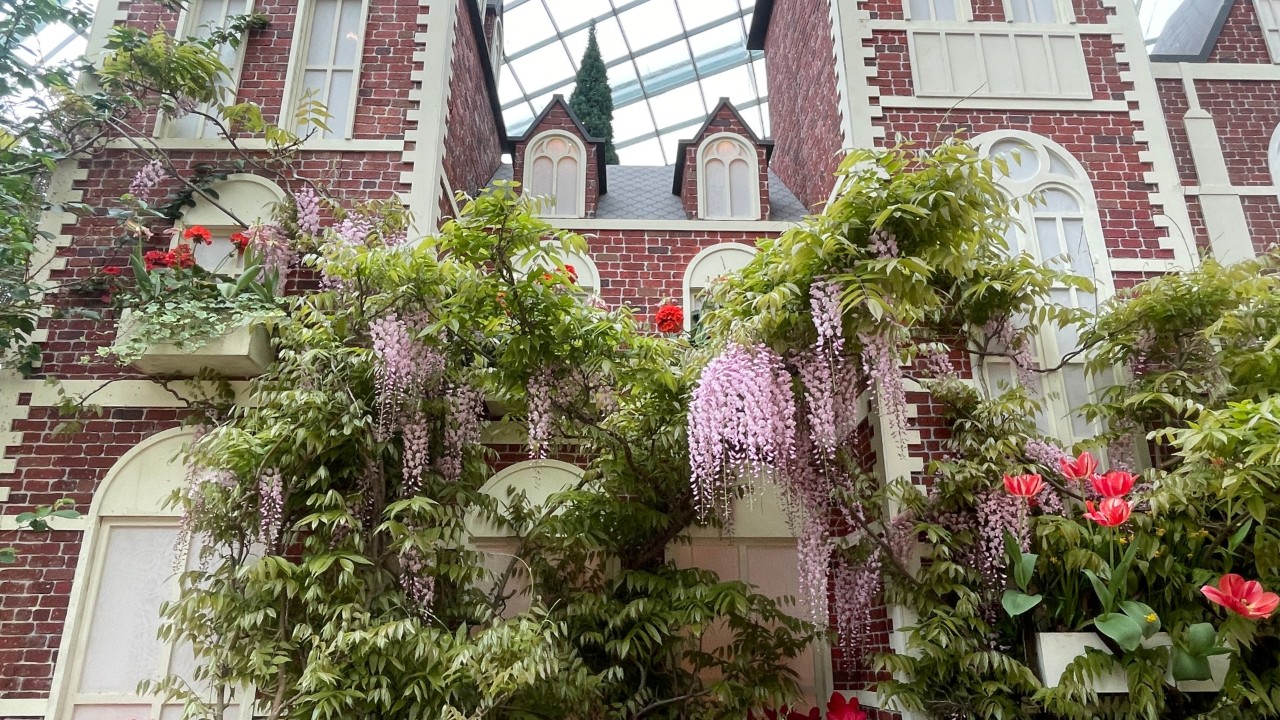 Did you know that in addition to shades of purple, different Wisteria cultivars also have been selected with flowers in shades of pink and white? If you came to our Tulipmania 2026 display, you might have seen these two large pink-flowered wisteria vines, cultivated by the same Japanese grower, arching across the entrance of our recreation of the Rijksmuseum. If not, here’s a peek of part of those plants in full bloom!
These long, pendulous flower clusters (a type of inflorescence called a raceme) continuously elongate as the main stalk (rachis) lengthens as the flowers on it develop and open. Ours have been measured to increase from 4 to 10cm in length a day, sending a sweet fragrance into the air as they start to bloom, with the topmost flowers opening first and bloom proceeding downwards to the tip! The main flower stalk continues to elongate even as the individual flowers on it bloom, wither, and fall off, if not successfully pollinated and fertilised.
Depending on the weather and temperatures, full bloom may only last for a week to a week and a half, with peak bloom for 3 to 4 days in the middle of this period, so come down and take your best selfies with this blue (or purple!) beauty as soon as you can!
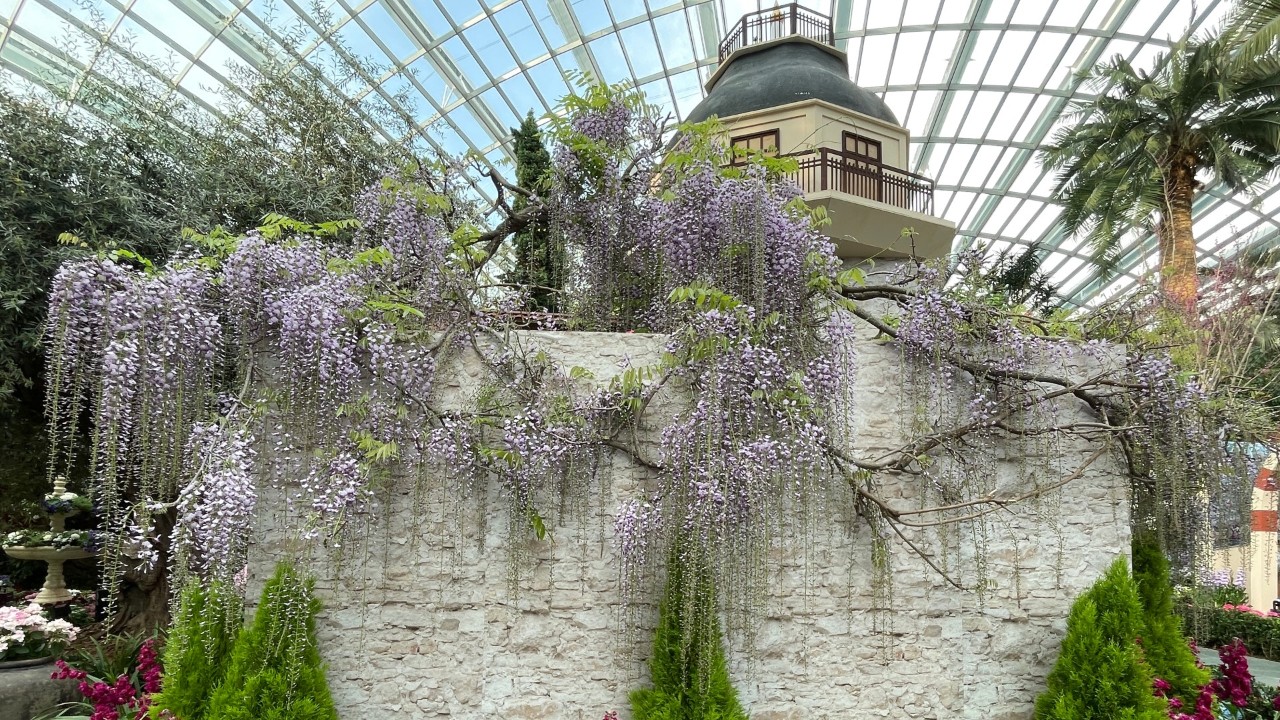
Find this magnificent wisteria draped around and over our recreation of the Maiden’s Tower at the Blue Beauties display in Flower Dome!
Written by: Janelle Jung, Senior Researcher (Research and Horticulture)
A transplanted pake (Hawai'i-born Chinese), she's finding her own Singaporean roots. Every plant has a story, and Janelle helps discover and share these with colleagues and guests, hoping to spark a mutual plant passion! Ask her what plant she named her cat after!
This article is part of our What's Blooming series.
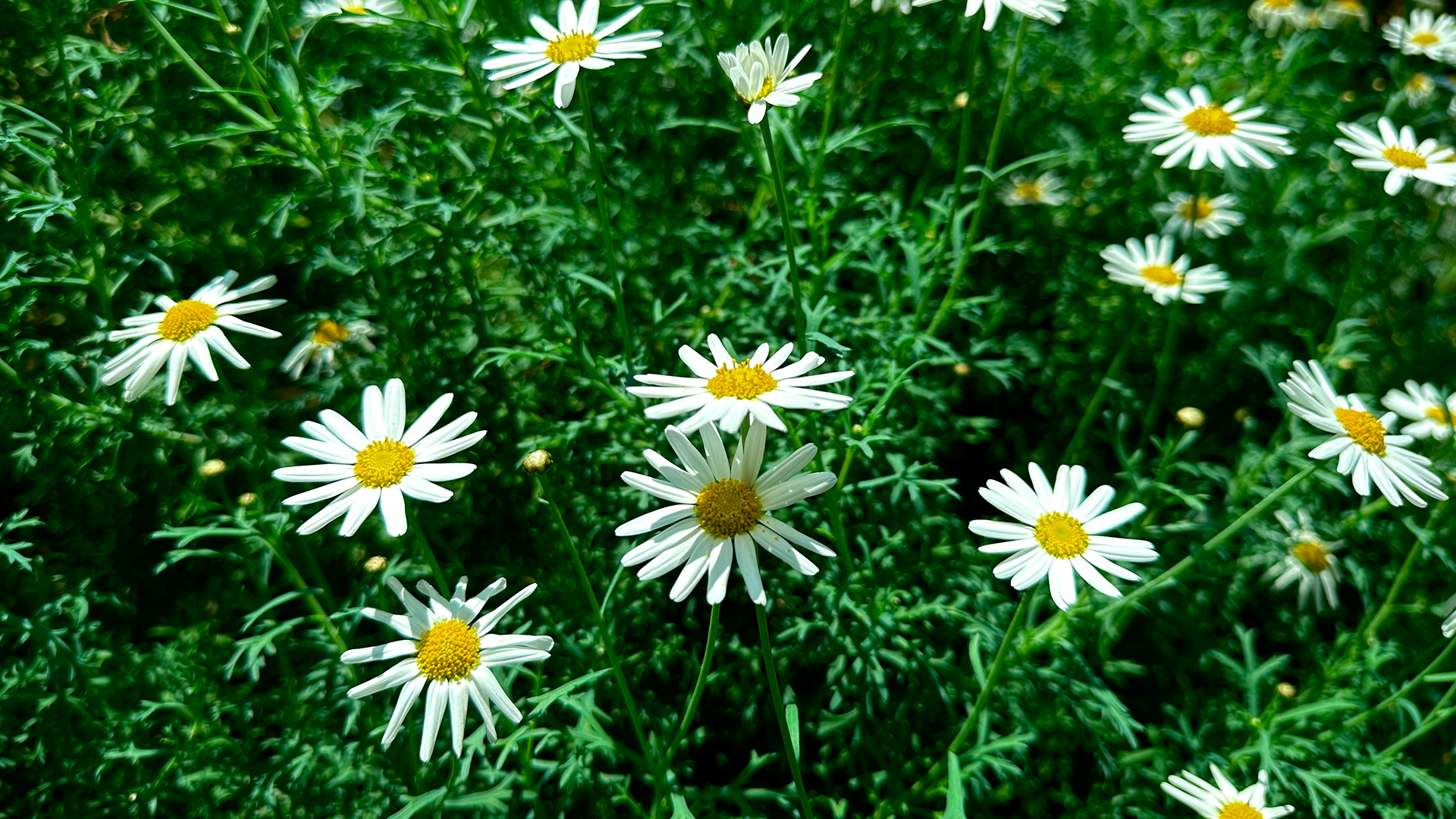
Read Next: Marguerite Daisy (Argyranthemum frutescens)
One plant that gives off a cheerful Mediterranean summer garden vibe is in blossom right now in Flower Dome, so don’t miss it!
You may also be
interested in
 Back To Top