 Advisory for use of tripods at Disney Garden of Wonder at Floral Fantasy
For a better visiting experience and facilitate crowd movement, we seek your kind understanding that usage of tripods and camera stands will not be permitted in Floral Fantasy.
Bay South–Bay East Bridge Construction from 4 May 2026
To facilitate the construction of the bridge linking Bay South Garden and Bay East Garden, there will be no access for cyclists along the Waterfront Promenade from 4 May 2026. During the construction of the bridge, cyclists heading towards Marina Barrage are advised to take an alternative route around the perimeter of Bay South Garden. Pedestrians may still access the Waterfront Promenade, with a slight diversion to their route.
Click here to download the diversion map.

{{ suggestion.item }}
{{ noOfResults }} results found for "{{ submittedQuery }}"
Filter by
({{ currentFilters.length }})

Showing {{ searchResults.length }} out of {{ noOfResults }}
{{ result.category.label }}
We’re sorry. 0 results found for "{{ submittedQuery }}"
Try doing these:
- Check your spelling
- Try more general words
- Try different keywords
Hydrangea paniculata ‘Sundae Fraise’
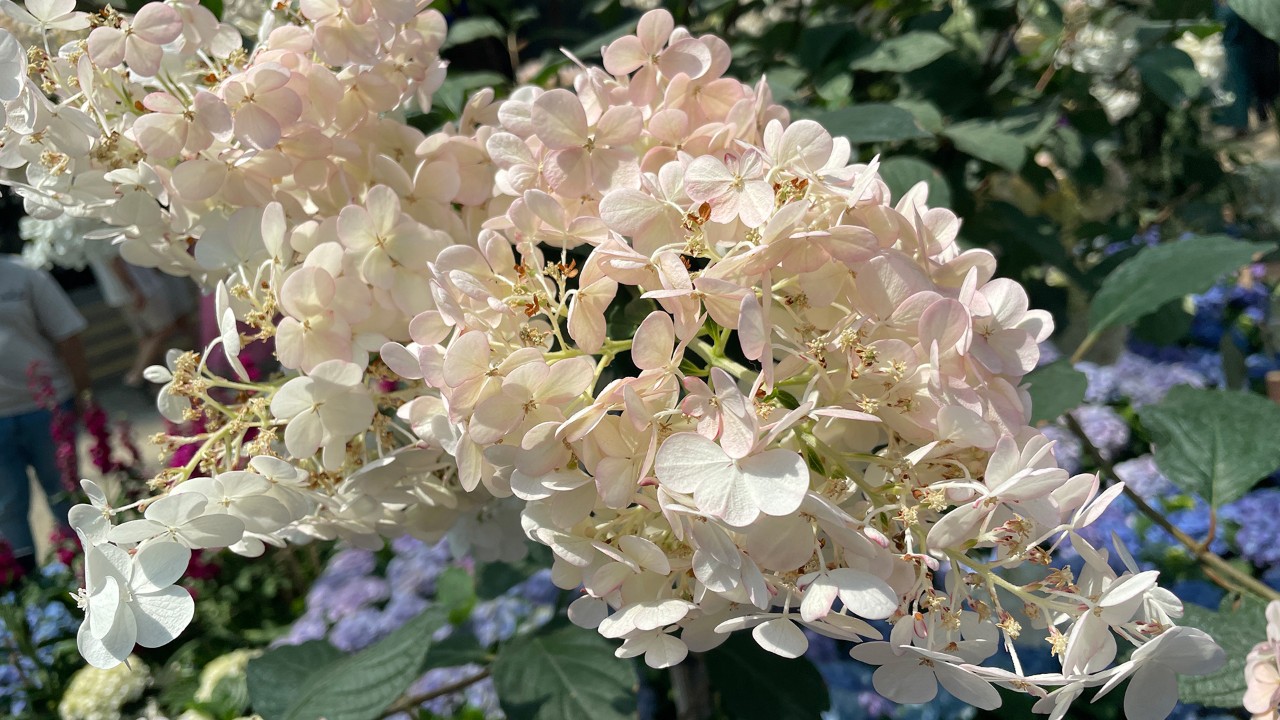
Hydrangeas (Hydrangea species and cultivars), always the centre of attention, are well known for their large blooms and pretty shades of blue, pastel pink and vibrant red. This year, we’re debuting a sweet new cultivar Hydrangea ‘Sundae Fraise’. Its cone-shaped flower clusters start pure white, then blush a bright pink as the flowers mature, just like a strawberry sundae!
Fun fact: Interestingly, yellow and oranges warm hues are absent from the range of hydrangea flower colours because hydrangeas lack the ability to produce carotenoids – orange or yellow pigments, like those found in carrot roots. Instead, hydrangea flower colours are due to the red, blue, or purple colours of another family of pigments called anthocyanins, which also shift in colour depending on the soil pH value and presence of aluminium ions in acidic soil, which are then taken up into the plant. The large, petal-like sepals are a pink to red hue in alkaline or basic soil but shift to purple or blue when grown in increasingly acidic soils rich in soluble aluminium ions that bind to the red anthocyanin pigments, shifting their red to cooler blue tones! In a way, hydrangeas may be considered a rough indicator of soil alkalinity or acidity.
Hydrangea blooms are not 'flowers', they are made up of modified leaves that protect the true flowers. Each tiny, hydrangea flower is surrounded by a cluster of much larger, petal-like sepals rendering the other flower parts- the petals, anthers, and carpel, almost unnoticeable!
The blooms that are seen are a cluster of flowers called a panicle, in which each branch of the main flower stalk bears multiple flowers which bloom outwards or downwards, with the youngest flowers at the tip or centremost.
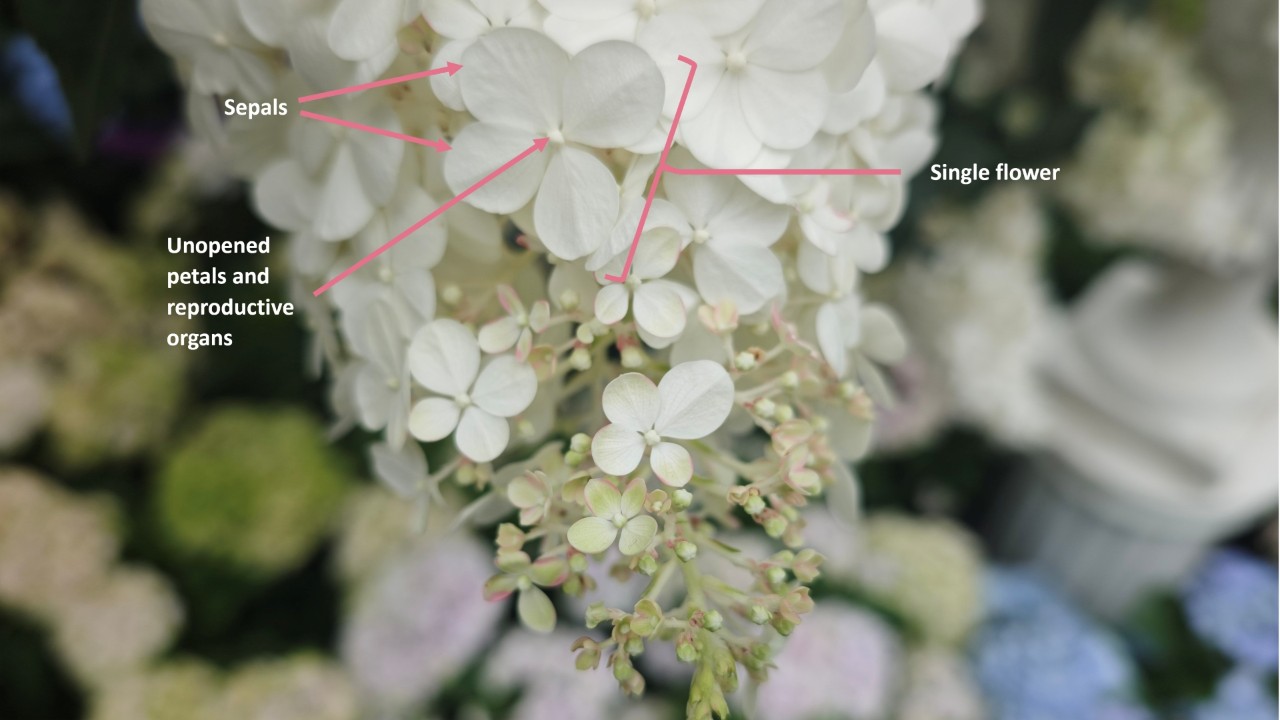 Labelled panicle of hydrangea showing a single flower with broad, petal-like sepals surrounding the other flower parts.
There are about 100 species in the genus Hydrangea, mostly shrubs or small trees native to a wide range of East Asia, including China, Japan, and Korea, with a few species native to North America. While with their large and vibrant inflorescences, cultivated varieties of bigleaf hydrangea (Hydrangea macrophylla) native to Japan, has long been the most loved showy species in our shows. This year, Gardens by the Bay has also brought in several cultivars of panicle hydrangea (H. paniculata), native to parts of China, Japan, and the Sakhalin and Kuri islands of Russia, that are more heat-tolerant and have a longer flowering period than the bigleaf hydrangea.
Hydrangea paniculata 'Sundae Fraise' is a compact panicle hydrangea with an upright form, cultivated for its bushy and well-balanced growth and large panicles of white flowers that gradually blush pink.
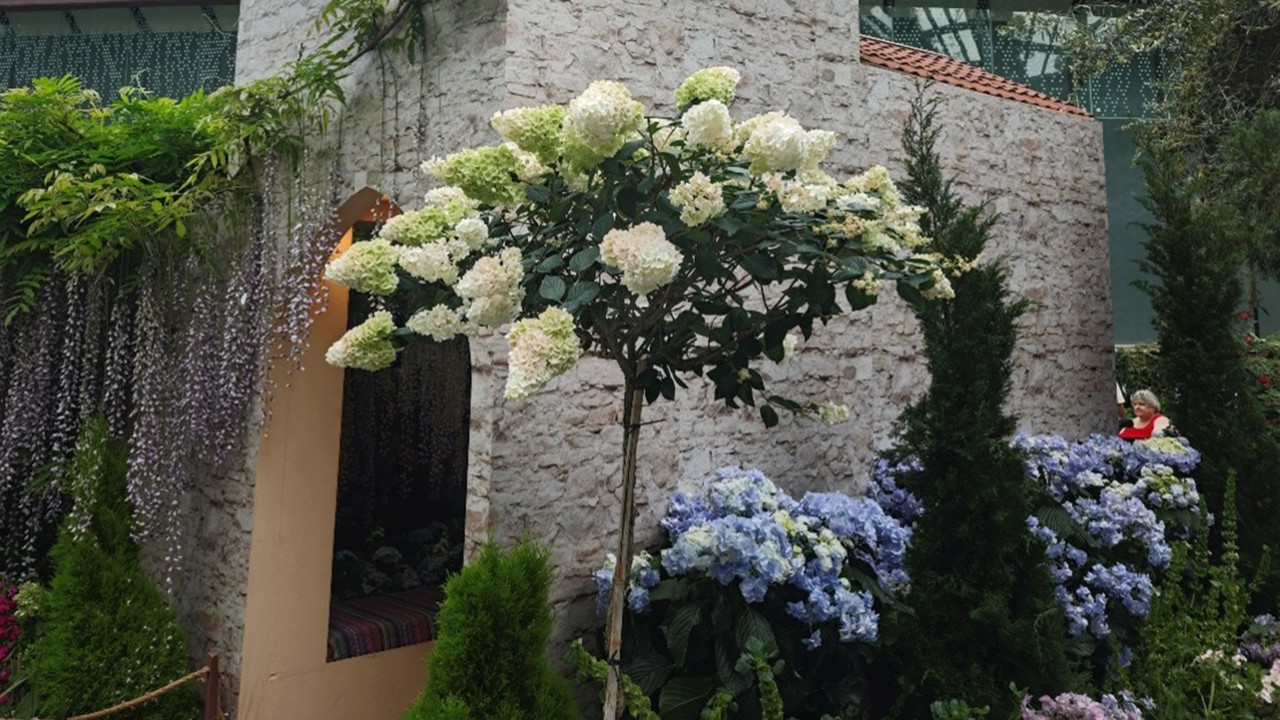 Selective pruning transforms a shrubby hydrangea into a tall, lollipop-like form resembling a tree!
Gardens by the Bay has brought in Hydrangea paniculata ‘Sundae Fraise’ in a standard or ‘lollipop’ form, made by selectively pruning each shrubby plant to have a long bare stem or ‘trunk’ and a rounded leafy, flowering top. This form is unusual as Hydrangea cultivars are more commonly cultivated as low lying bushes in landscaping designs. The tall tree-like standard form adds height, structure, and oomph to the garden display.
The modified sepals of panicle hydrangeas which are less colourful than bigleaf hydrangea cultivars and come in tones of cream white to pink. Sepal colour is not affected by soil pH, but sepal reddening is enhanced in certain cultivars, high light intensity, and cool night temperatures as its flowers age. It has abundant green and white sterile flowers that turn ombre shades of pink.
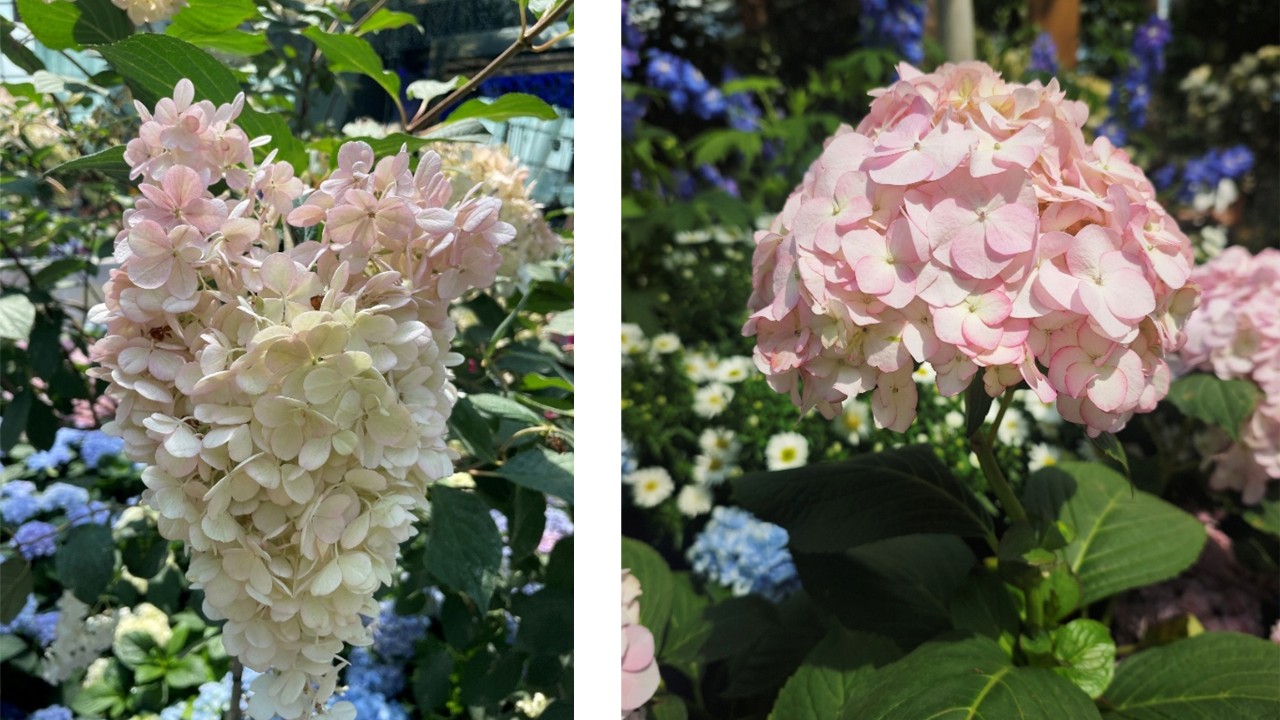 Other than its height, the other difference between these two main hydrangea species is the cone-like flower shape of the panicle hydrangea left. (very much like hanging grapes) compared to the rounded flowering shape of the bigleaf hydrangeas (right).
Catch them in full bloom and check out the difference between the two plants yourself at the Blue Beauties display in Flower Dome.
This article is part of our What's Blooming series.
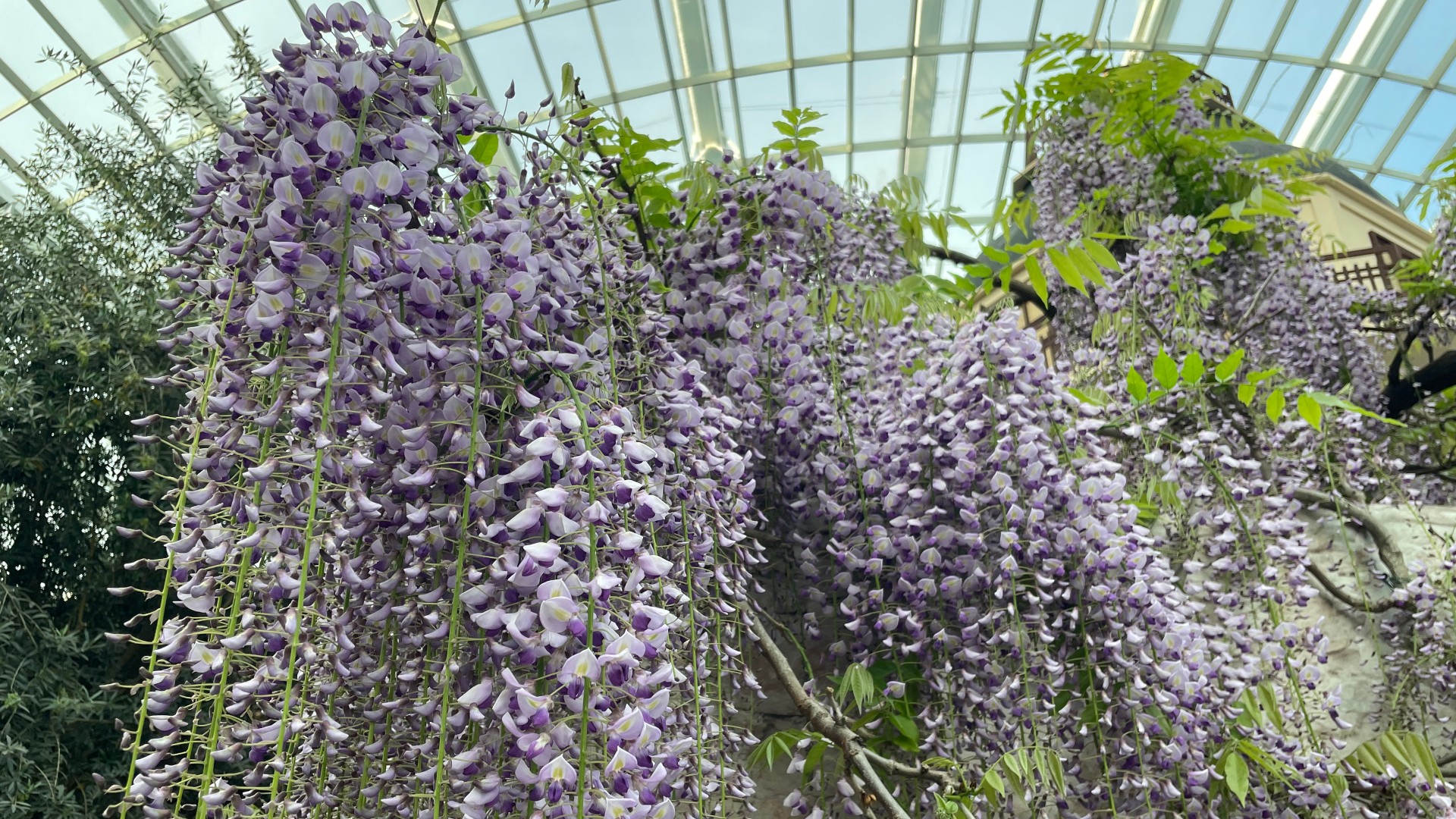
Read Next: Wisteria (Wisteria species and cultivars)
Can you believe these flower stalks can grow in length by over 10cm a day? Learn more about these blue beauties here!
You may also be
interested in

 Back To Top