 Closure of Supertree Observatory on 5 Nov 2026
Supertree Observatory will be closed on 5 Nov 2026 for Maintenance.
Closure of OCBC Skyway on 4 Nov 2026
OCBC Skyway will be closed on 4 Nov 2026 for maintenance.
Closure of IMBA Theatre on Thu, 5 Nov 2026
IMBA Theatre will be closed from 3.00pm to 7.00pm on Thu, 5 Nov 2026 for a private event.
Advisory for use of tripods at Disney Garden of Wonder at Floral Fantasy
For a better visiting experience and facilitate crowd movement, we seek your kind understanding that usage of tripods and camera stands will not be permitted in Floral Fantasy.
Bay South–Bay East Bridge Construction from 4 May 2026
To facilitate the construction of the bridge linking Bay South Garden and Bay East Garden, there will be no access for cyclists along the Waterfront Promenade from 4 May 2026. During the construction of the bridge, cyclists heading towards Marina Barrage are advised to take an alternative route around the perimeter of Bay South Garden. Pedestrians may still access the Waterfront Promenade, with a slight diversion to their route.
Click here to download the diversion map.

{{ suggestion.item }}
{{ noOfResults }} results found for "{{ submittedQuery }}"
Filter by
({{ currentFilters.length }})

Showing {{ searchResults.length }} out of {{ noOfResults }}
{{ result.category.label }}
We’re sorry. 0 results found for "{{ submittedQuery }}"
Try doing these:
- Check your spelling
- Try more general words
- Try different keywords
Erect-lobed Spider Flowers (Grevillea erectiloba)
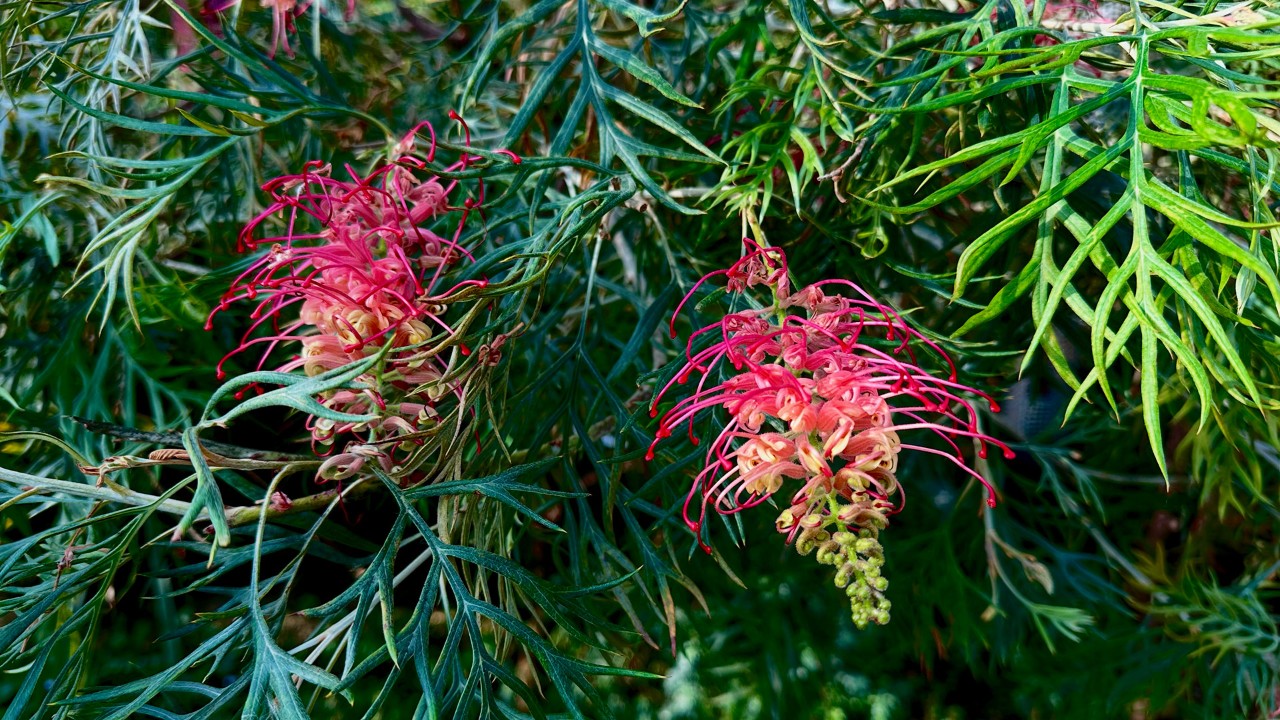
The erect-lobed spider flower (Grevillea erectiloba) belongs to the Proteaceae family - an evolutionarily ancient group of flowering plants primarily native to the Southern Hemisphere. It is classified within the genus Grevillea, commonly known as ‘spider flowers’ due to the delicate filament structures of their flowers, which resemble the spider legs. This species is endemic to Western Australia, thriving in semi-arid shrublands, woodlands, and sandy or gravelly soils.
Grevillea erectiloba grows as a bushy, rounded evergreen shrub. Its foliage features distinctively divided leaves measuring between 60 to 100 mm long. Each leaf features up to 15 thin, needle-like linear lobes with the edges curving downward. Echoing the finely divided leaves are the flower stalks, each featuring dozens of small flower buds that develop successively with bloom starting from the flowers at the base of the stalk and progressing slowly toward the tip. In its earliest stages, each flower bud is a pale, bright green. As the flowers open, their fused tubular petals undergo a striking colour shift, turning from a brilliant bright red to pinkish red, giving each developing inflorescence a striking ombre effect!
Each flower features a narrow perianth tube (a cylindrical structure formed when the outer parts of a flower - the sepals and petals, or undifferentiated tepals - fuse together at their bases) paired with an extended, thread-like style (the long, slender stalk that connects the stigma at the top to the ovary at the base of a pistil - the female reproductive organ of the flower) measuring 20 to 35 mm long. The primary pollinators for Grevillea species are nectar-feeding birds, such as honeyeaters and wattlebirds, which are drawn to vivid red, pink, or orange flowers, alongside insects such as bees and beetles and occasional small mammals visiting paler, less visually attractive flowers or ground-level species.
Speaking of pollination, here comes the most fascinating part of a Grevillea flower! Instead of presenting its pollen on its anthers - the male, pollen-bearing organs – as most flowers do, it has evolved a special adaptation called secondary pollen presentation, where other floral structures, such as the style, a female flower part, picks up pollen off the anthers and present it to pollinators instead. To prevent self-pollination, Grevillea flowers also exhibit protandry, a timing delay where male parts mature before female parts. Taken together, this means Grevillea flowers have one of the most sophisticated and highly specialised pollination strategies in the plant kingdom!
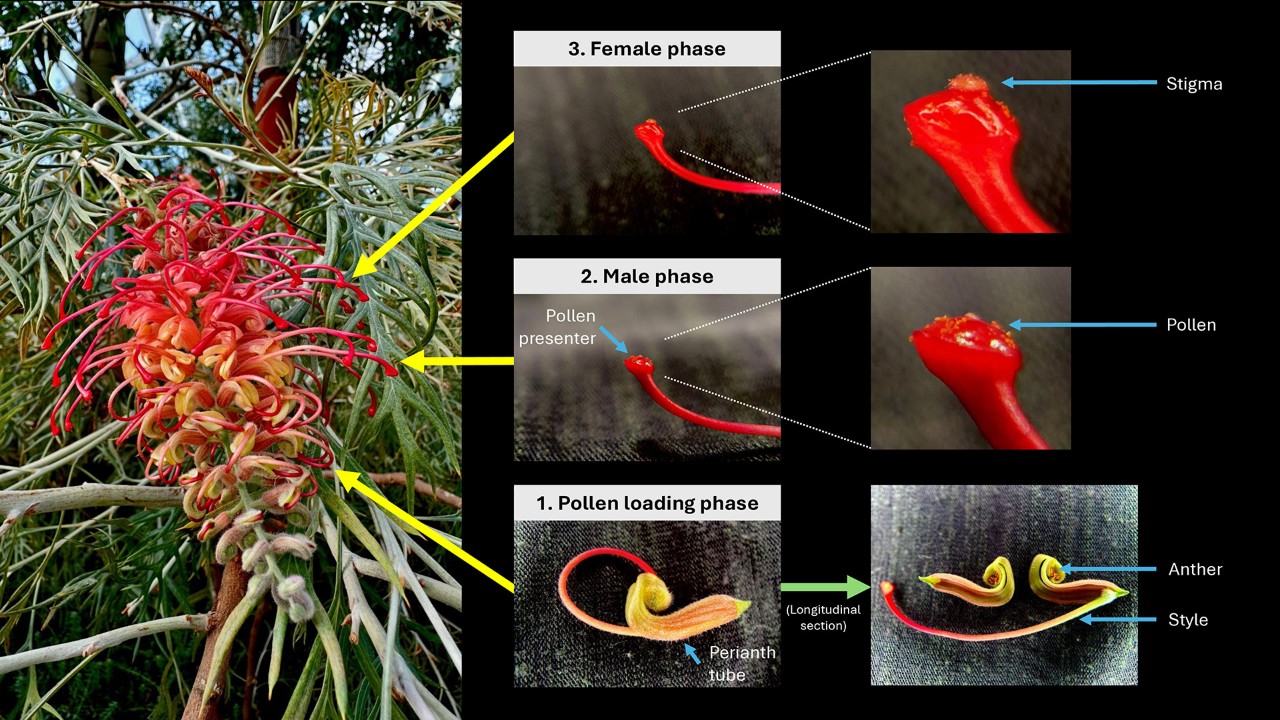 The 3 phases of secondary pollen presentation combined with protandry can be observed on multiple flowers in different developmental stages borne on the same inflorescence. Look closely, the stigma emerges at the centre of the previous pollen presenter in the female phase.
The pollination mechanism occurs in three distinct phases:
- Pollen loading phase: Before the flower opens, the male anthers become mature and release pollen directly onto a specialised disk at the tip of the female style, called the pollen presenter.
- Male phase (Presentation): As the flower opens, the long, spring-like style loops outward and releases, presenting its pollen to brush against visiting bird, insect, or mammal pollinators who have come to drink nectar at the inner base of the flowers.
- Female phase (Receptivity): Once the flower's own pollen is carried away or becomes unviable due to heating up or drying out, the stigma at the centre of the disk becomes mature and ready to receive fresh pollen delivered from other plants by the pollinator.
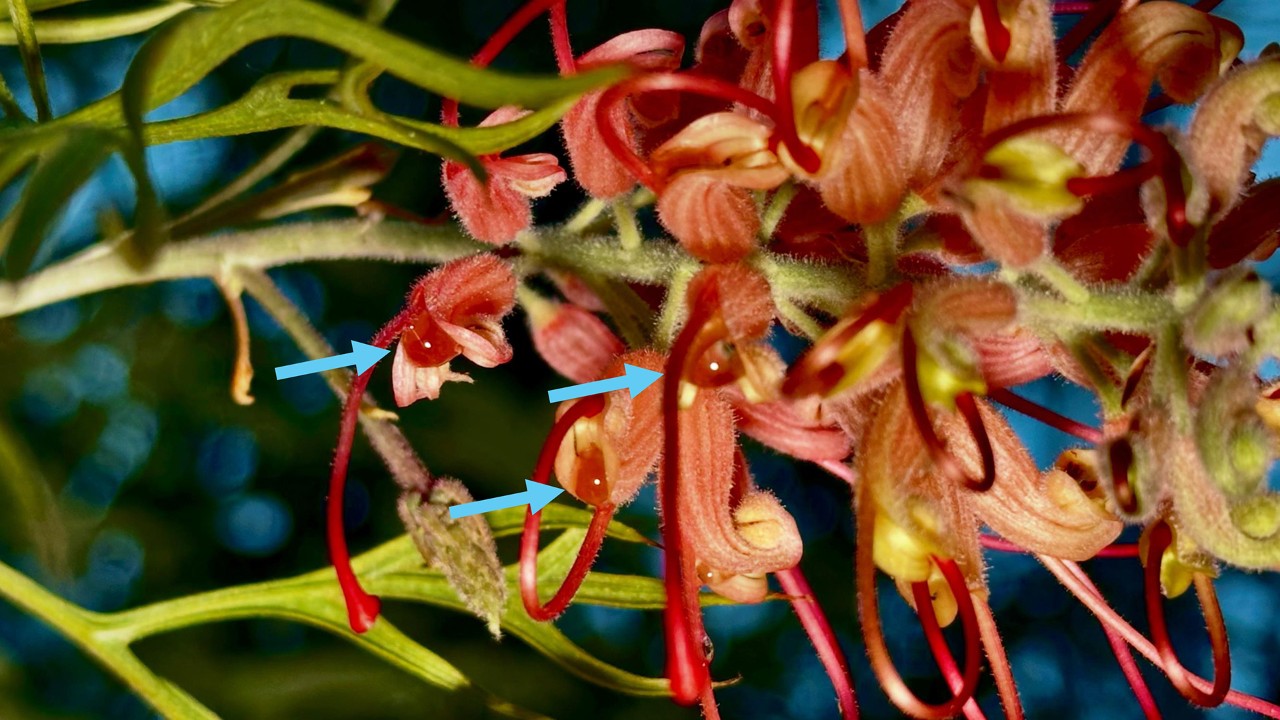 The blue arrows indicate the exuding nectar droplets. Imagine yourself as a pollinator flying up and down around the shrubs, don’t they look tempting to you?
This ingenious, precisely timed pollination mechanism ensures accurate and thrifty pollen placement on a pollinator's head or body exactly where it needs to be delivered to the next Grevillea flower its pollinator visits. It also cleverly minimises the occurrence of undesirable self-pollination, which can reduce genetic diversity and the ability to adapt to changing climates or emerging diseases!
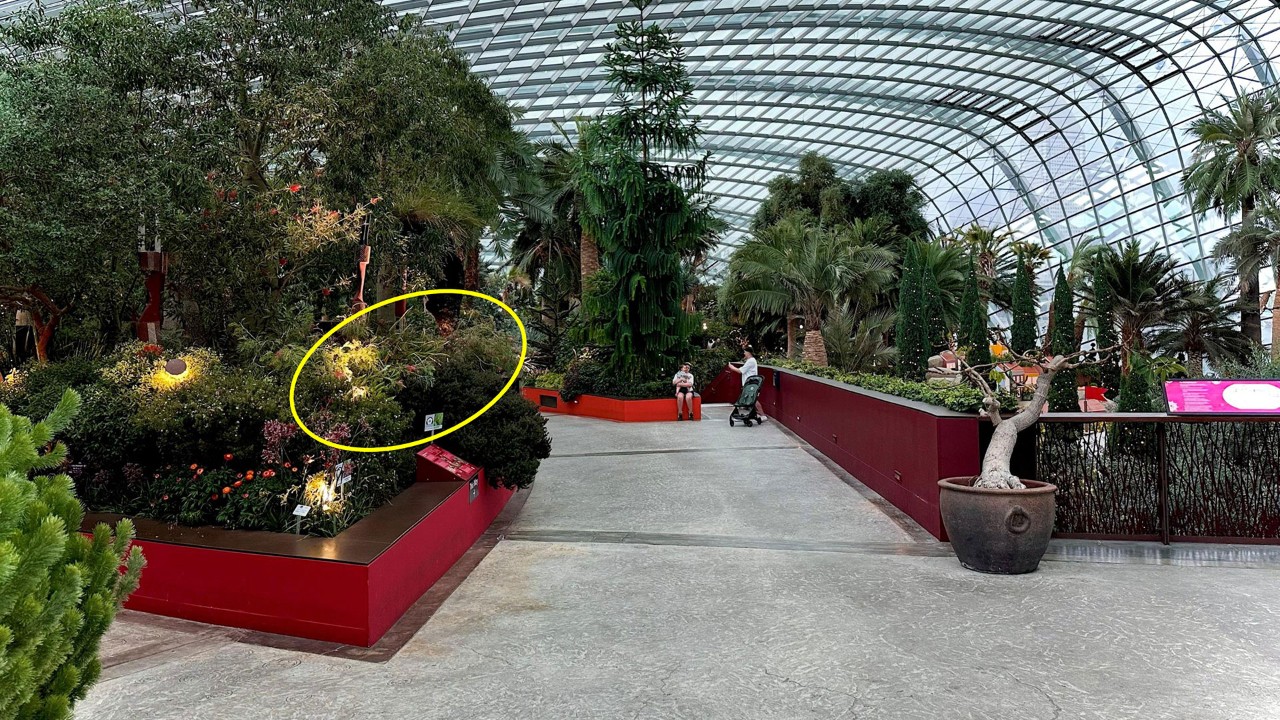 You can find the erect-lobed spider flowers here in Australian Garden, Flower Dome!
Turn left after you enter Flower Dome and you will see this intriguing erect-lobed spider flowers and many other relatives in the same genus in the first theme garden - Australian Garden! Don’t forget to take a closer look at the flower to witness the sophisticated pollination mechanism!
Zeke Chen, Manager (Conservatory Operations)
Ever since his tiny hands could hold on to a small toy shovel and sowed the first apricot seed in the garden, the passion for plants has started to grow in Zeke’s heart.
This article is part of our What's Blooming series.
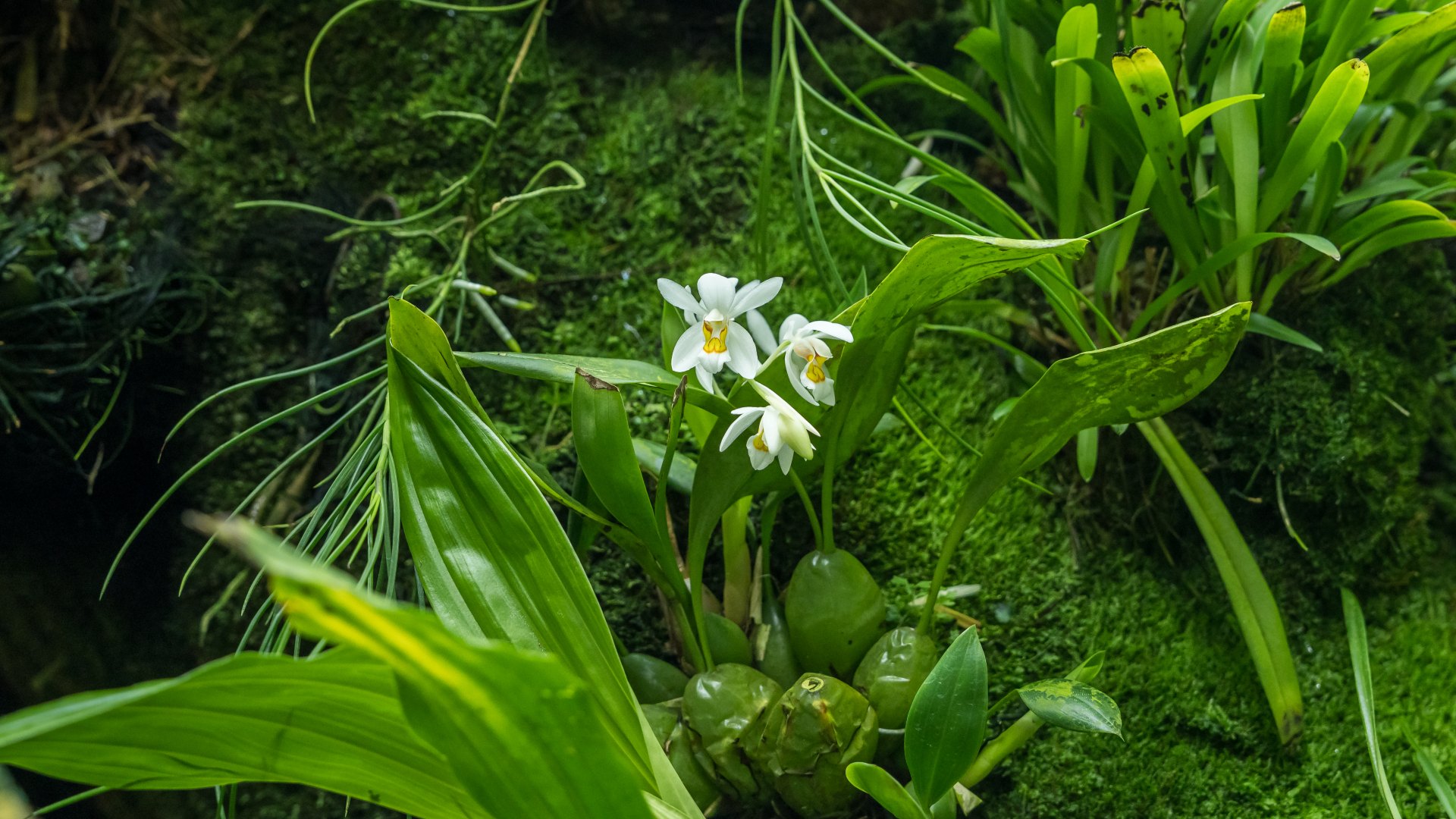
Read Next: The Shining Coelogyne (Coelogyne nitida)
The shining coelogyne is an ultimate trickster - its bright yellow spots look like pollen, but it's all a ruse to get bees and hoverflies to do its pollinating work!
You may also be
interested in


 Back To Top