 Advisory for use of tripods at Disney Garden of Wonder at Floral Fantasy
For a better visiting experience and facilitate crowd movement, we seek your kind understanding that usage of tripods and camera stands will not be permitted in Floral Fantasy.
Bay South–Bay East Bridge Construction from 4 May 2026
To facilitate the construction of the bridge linking Bay South Garden and Bay East Garden, there will be no access for cyclists along the Waterfront Promenade from 4 May 2026. During the construction of the bridge, cyclists heading towards Marina Barrage are advised to take an alternative route around the perimeter of Bay South Garden. Pedestrians may still access the Waterfront Promenade, with a slight diversion to their route.
Click here to download the diversion map.

{{ suggestion.item }}
{{ noOfResults }} results found for "{{ submittedQuery }}"
Filter by
({{ currentFilters.length }})

Showing {{ searchResults.length }} out of {{ noOfResults }}
{{ result.category.label }}
We’re sorry. 0 results found for "{{ submittedQuery }}"
Try doing these:
- Check your spelling
- Try more general words
- Try different keywords
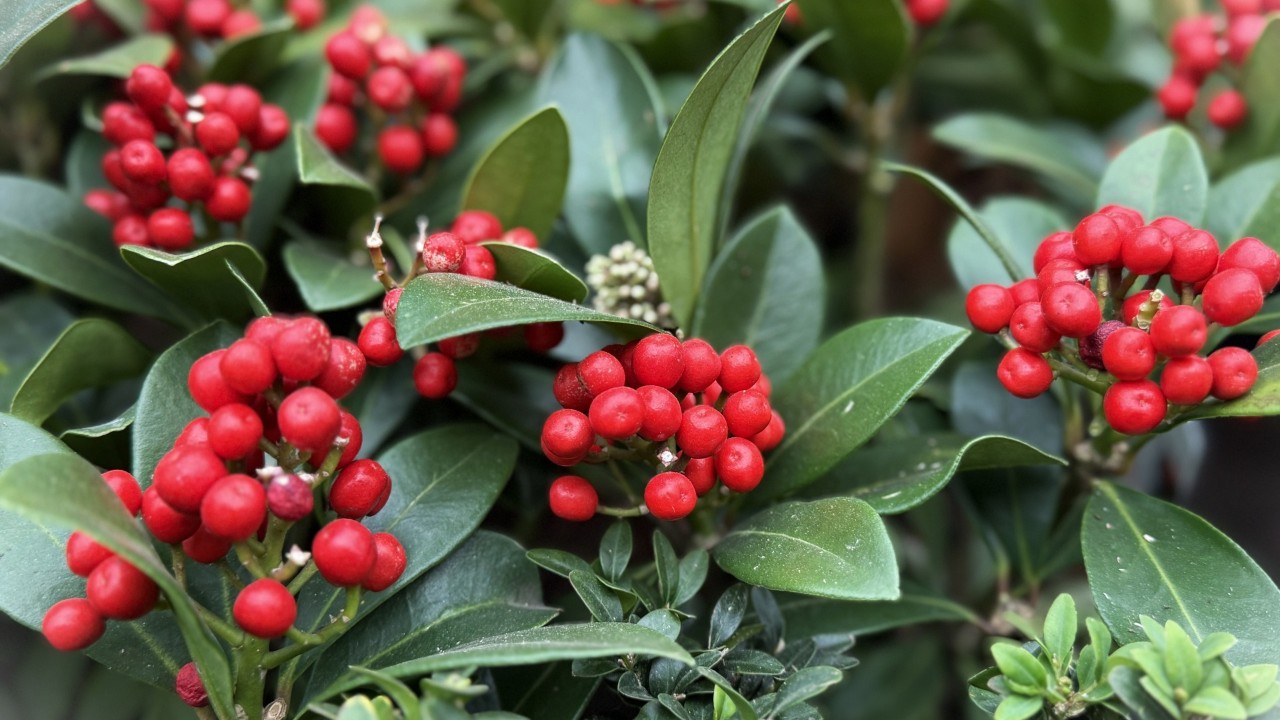 Rich displays of polished red berries that stand out through winter.
Skimmia comprises four shade-tolerant evergreen shrub species that share a broadly similar appearance but vary widely in size, with many compact forms ideal for smaller gardens. A member of the citrus family, Rutaceae, their genus name is latinized from the word shikimi, which is the Japanese name for Japanese star anise (Illicium anisatum), as well as the Japanese name for Skimmia japonica, which is miyama shikimi. Japanese skimmia (Skimmia japonica), native to East Asia, naturally inhabits forested mountain areas, where it thrives in the cool, shaded understory conditions, underlying its preference for dappled shade and humus-rich, acidic soils in cultivation.
 Close-up of the developing flower buds which naturally bloom in spring.
Skimmia provide visual interest through the colder months and are valued for bringing structure and winter colour to the garden. They pair well with deciduous shrubs that drop their leaves in the fall, such as witch-hazel (Hamamelis spp. and cultivars), adding an evergreen presence when most plants are bare.
In the wild, Skimmia species flower in spring and are pollinated by insects, particularly bees, hoverflies, and other small flies. Their small but fragrant flowers produce nectar early in the season, attracting pollinators when few other plants are in bloom. Most wild Skimmia are dioecious, meaning male and female flowers occur on separate plants: male plants produce flowers that bear pollen and tend to have showier blossoms, while female plants receive pollen and bear the berries. Insects transfer pollen as they move between the flowers of different plants, and the flowers’ strong fragrance helps draw pollinators to the plants in the dim forest understory where Skimmia naturally grows. After successful pollination and fertilisation in the spring, Japanese skimmia fruits ripen to a brilliant red in the fall and are thought to be eaten and dispersed by birds in its native range.
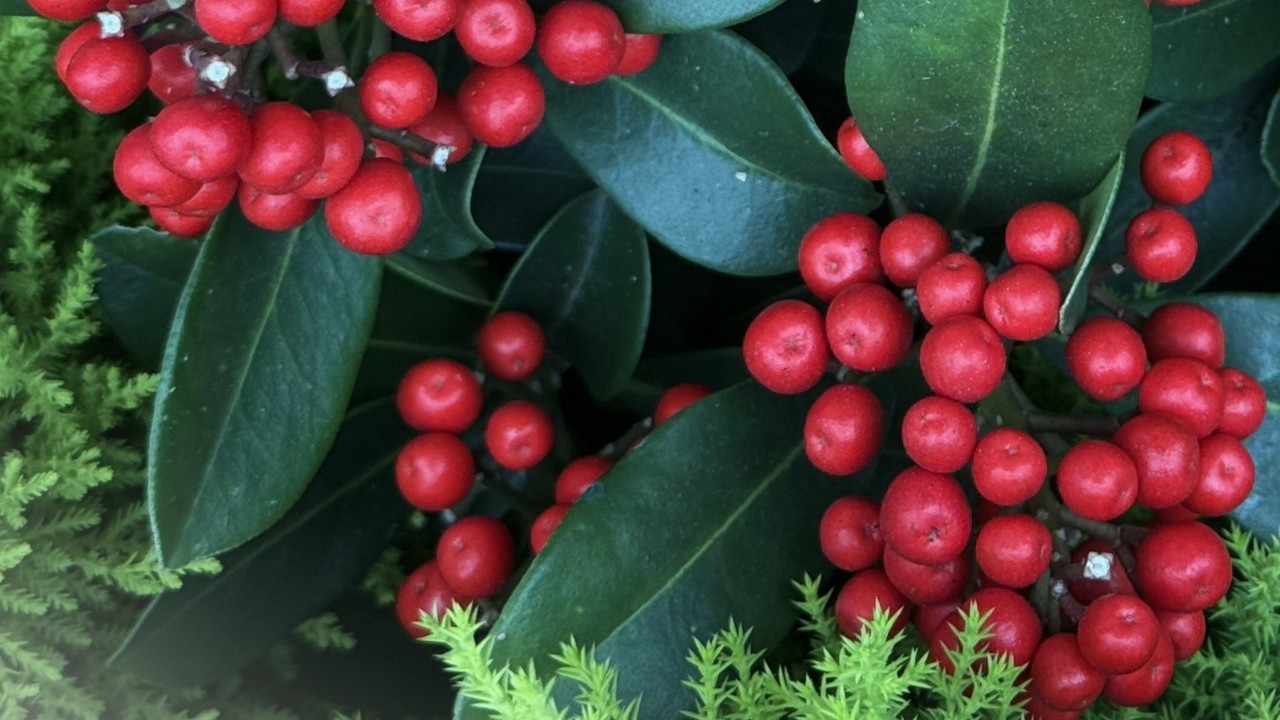 Close-up of the bright red berries of Skimmia japonica ‘Temptation’ against its glossy green leaves.
Skimmia japonica ‘Temptation’ is a relatively new cultivar selected in 2005. It is notable for its self-pollinating flowers with both male and female parts on the same plant, prolific red fruit, and compact yet vigorous habit, forming a neat evergreen shrub about 70 cm tall. Its elliptic, glossy green leaves release a pleasant citrusy aroma when crushed. Tiny white flowers open in spring, while by autumn the developing buds take on colour and hold through winter alongside masses of shiny, vivid red berries. These inedible but highly ornamental fruits are produced, hence the name ‘Temptation’, and are often still on the shrub as new blossoms appear the following spring.
Unlike wild Skimmia, a few modern cultivars such as ‘Temptation’ are hermaphroditic (both male and female reproductive parts are found on the same plant) and self-fertile, eliminating the need for growing separate male and female plants for fruit development and ensuring reliable berry production even when grown alone. Its dependable fruiting, aromatic foliage, spring flowers, and vivid winter berries make it an excellent choice for year-round interest. Skimmia japonica ‘Temptation’ is the result of more than 20 years of careful selection at Wageningen University in the Netherlands, where it was finally chosen by the breeder in 2005.
As an alternative to holly, this prickly-free shrub with its festive red berries is perfectly suited for Christmas displays, offering all the red and green colour with none of the pain. Look out for these eye-catching plants in the Flower Field area of Flower Dome, nestled among the miniature train landscapes in Gardens by the Bay’s Christmas Train Show 2025!
Written by: Ziana Yacob, Senior Manager (Research and Horticulture)
Ziana's fascination with the many wonders of plants led her to study Horticulture. She has been involved in propagating and nurturing in-house plant collections, with a special focus on orchids. Keeping plants thriving is both a rewarding challenge and a continuous journey of learning for her!
You may also be
interested in
 Back To Top