 Advisory for use of tripods at Disney Garden of Wonder at Floral Fantasy
For a better visiting experience and facilitate crowd movement, we seek your kind understanding that usage of tripods and camera stands will not be permitted in Floral Fantasy.
Bay South–Bay East Bridge Construction from 4 May 2026
To facilitate the construction of the bridge linking Bay South Garden and Bay East Garden, there will be no access for cyclists along the Waterfront Promenade from 4 May 2026. During the construction of the bridge, cyclists heading towards Marina Barrage are advised to take an alternative route around the perimeter of Bay South Garden. Pedestrians may still access the Waterfront Promenade, with a slight diversion to their route.
Click here to download the diversion map.

{{ suggestion.item }}
{{ noOfResults }} results found for "{{ submittedQuery }}"
Filter by
({{ currentFilters.length }})

Showing {{ searchResults.length }} out of {{ noOfResults }}
{{ result.category.label }}
We’re sorry. 0 results found for "{{ submittedQuery }}"
Try doing these:
- Check your spelling
- Try more general words
- Try different keywords
Cherry and Peach (Prunus spp. and cv.)
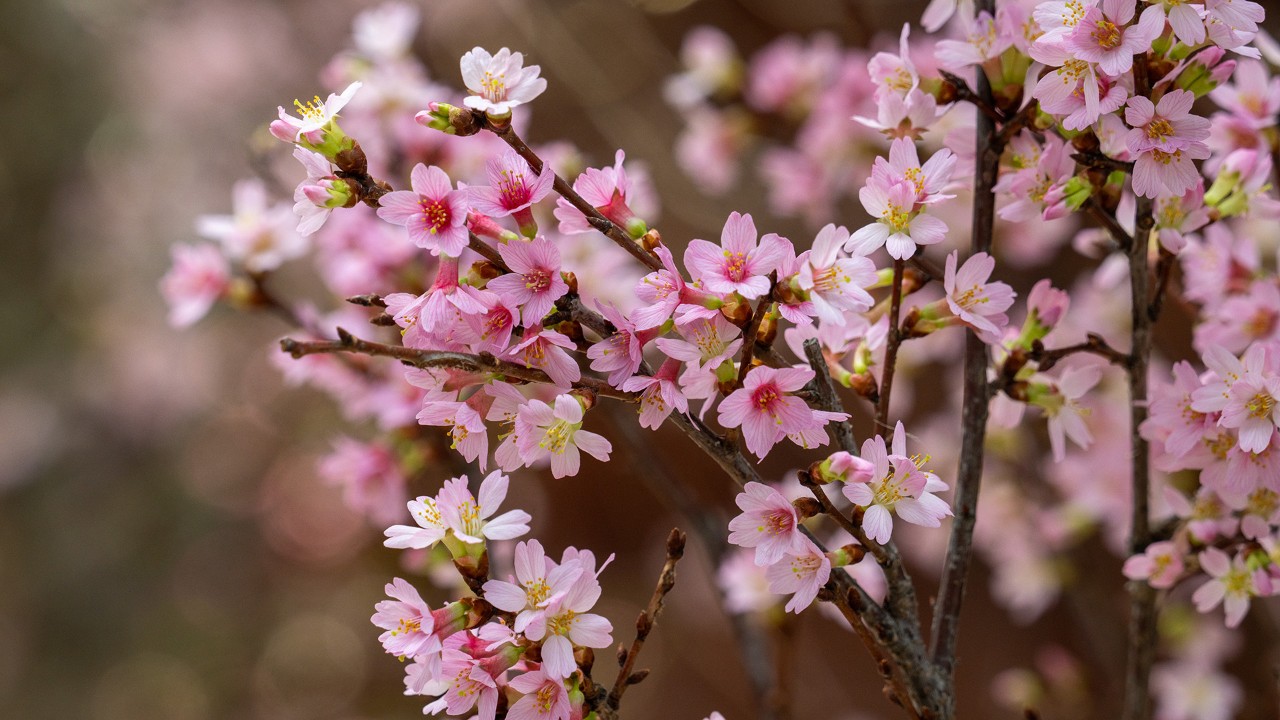
The genus Prunus in the family Rosaceae encompasses over 420 species of trees and shrubs, including cherry, peach, plum, apricot, and almond species, celebrated for their ornamental blossoms and delicious fruits. Within these Prunus species, various species may be interbred and cultivars selected for desirable traits such as flower colour, shape, size, and fragrance. While flowering cherry and peach share a familial resemblance, they possess some distinct characteristics in petal shape, stem length, blooming patterns, and fragrance, making each unique in appearance.
The trees in this year’s Sakura display may all look like cherry blossoms or sakura; however, with a closer look you may also find its close cousin, the peach, or momo in Japanese. At first glance, their flowers might look nearly identical, a soft blur of pink and white, but if you take a closer look, you’ll see some unique differences. From the shape of the petals to how the flowers are borne on the branches, here’s how to spot the difference between the two so you can impress everyone with your flower-spotting skills.
Cherry blossoms (Prunus pendula, P. serrulata, and other species and hybrids) are perhaps the most iconic flower of Japan. They are generally known for their split-tipped, heart-shaped petals and long peduncles, with several flowers – from two to eight or more! - emerging from a single node. The petals may be oval, egg-shaped, or upside-down egg-shaped, or even round petals, without a clear cleft, but with either a smooth round edge, or wavy, ruffled, edges. Typically, cherry stamens are less than half the length of the petals. Their flowers are usually pale pink to white and bloom in profusion from late March to April in eastern and western Japan. As the flower ages, the petal colours of some flowering cherry cultivars may even change noticeably in colour from a darker to lighter or lighter to darker shade, giving some cultivars a multicoloured or completely different appearance at the start and end of their blooming period! The long stems and clustered flower arrangement give cherry branches a light, airy appearance, and although cherry blossoms are visually striking, most cultivars emit little to no fragrance.
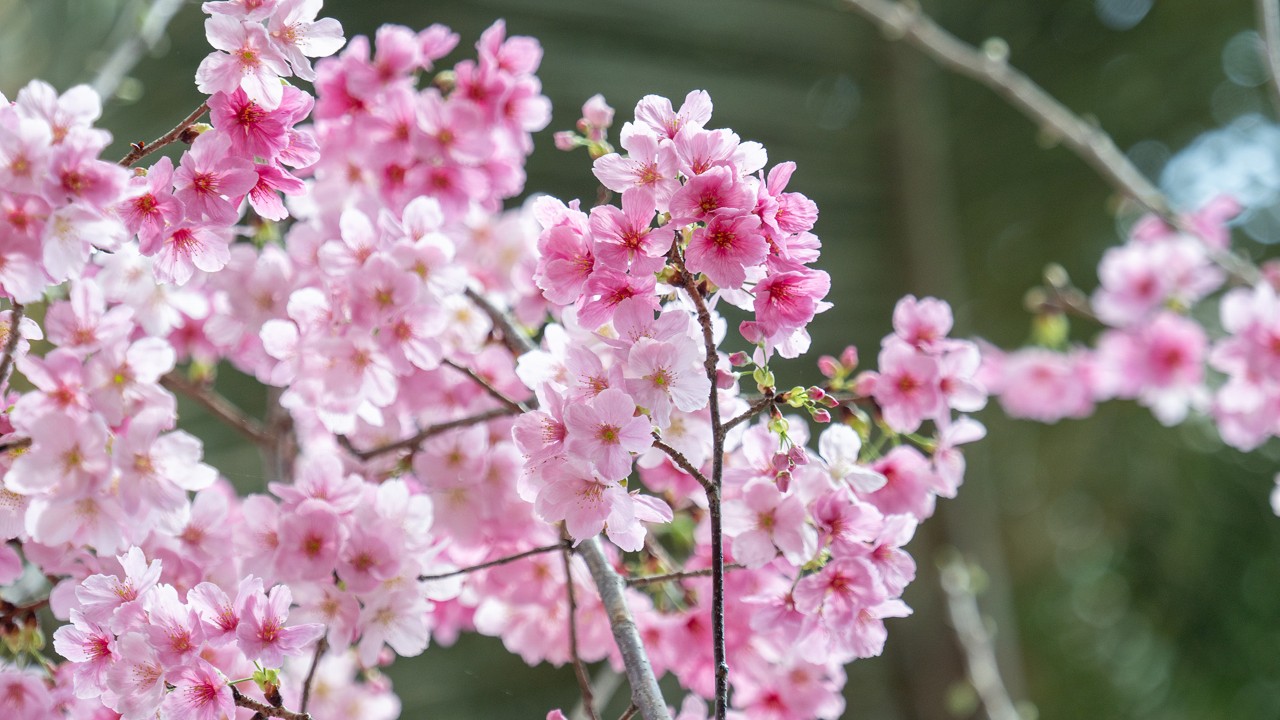 Cherry blossoms are the most iconic blooms in Japan. They are often cultivated for their ornamental value instead of their fruit-bearing capabilities. The flowers are typically pale pink to white flowers.
Peach blossoms (Prunus persica) bloom slightly later than plum trees, usually in early to mid-April. Peach flowers have oval or teardrop-shaped petals and are held on short, fat stems. Generally flowers emerge from buds on either side of a branch, giving peach trees a fuller and flashier appearance than plum trees. Peach flowers are generally more fragrant than cherries and are often a deeper shade of pink than most cherry blossoms, though we are featuring both single and double flowering peach cultivars with petals in white, pale pink, dark pink, and a vibrant, nearly red hue. Their paired flower arrangement near the stem adds to the overall vibrant and decorative effect.
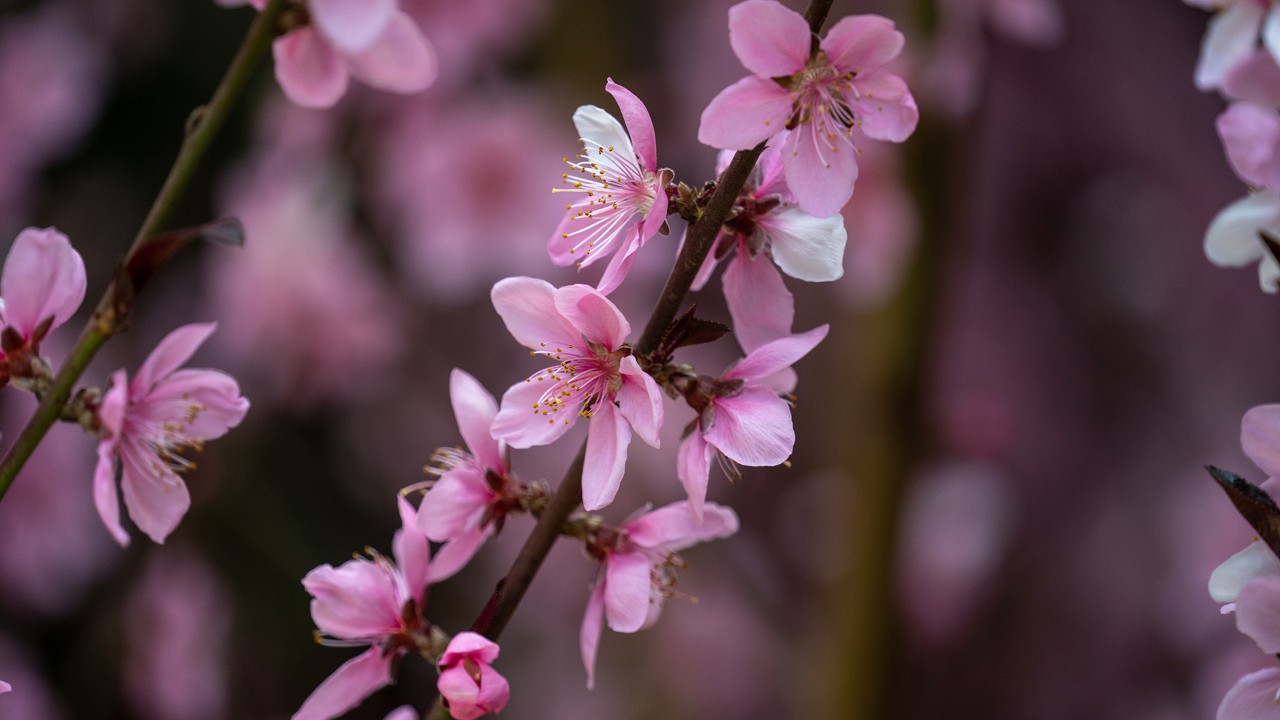 Peach blossoms, shown here, are typically fragrant and a deeper pink than most cherries. In this year’s display, we have several different peach cultivars displaying petal colours from white to a vivid, nearly red shade.
Now, view the paired photos below and see if you can tell apart cherry and peach flowers!
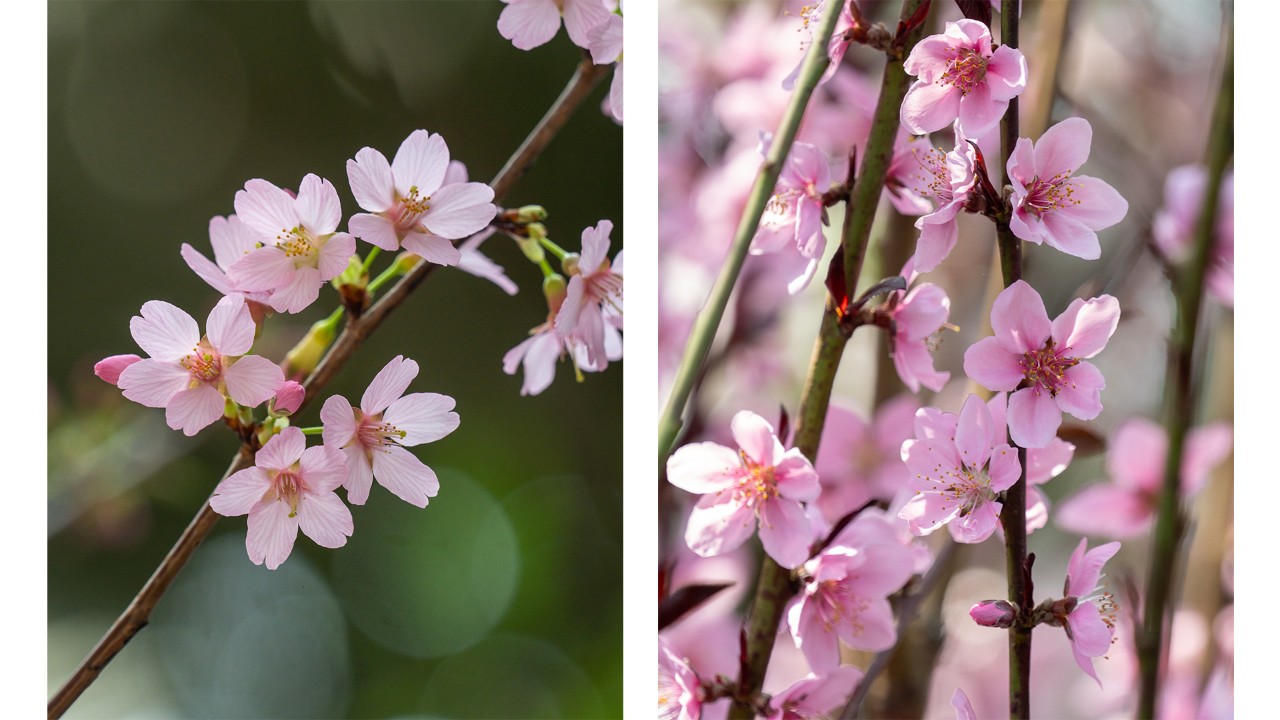 Differences in petal shape are easiest to see in ‘single-flowered’ cultivars of cherry and peach, both of which have five petals! If the flower has petals with a split or cleft in the tip, it is sure to be a flowering cherry (left). However, some flowering cherries have petals with no split tip, so this is not necessarily a sure trait to identify a cherry! Peach blossoms do not have split petal tips. They generally have oval or tear-drop shaped petals with a rounded or slightly pointed tip and a narrow or pointed base (right).
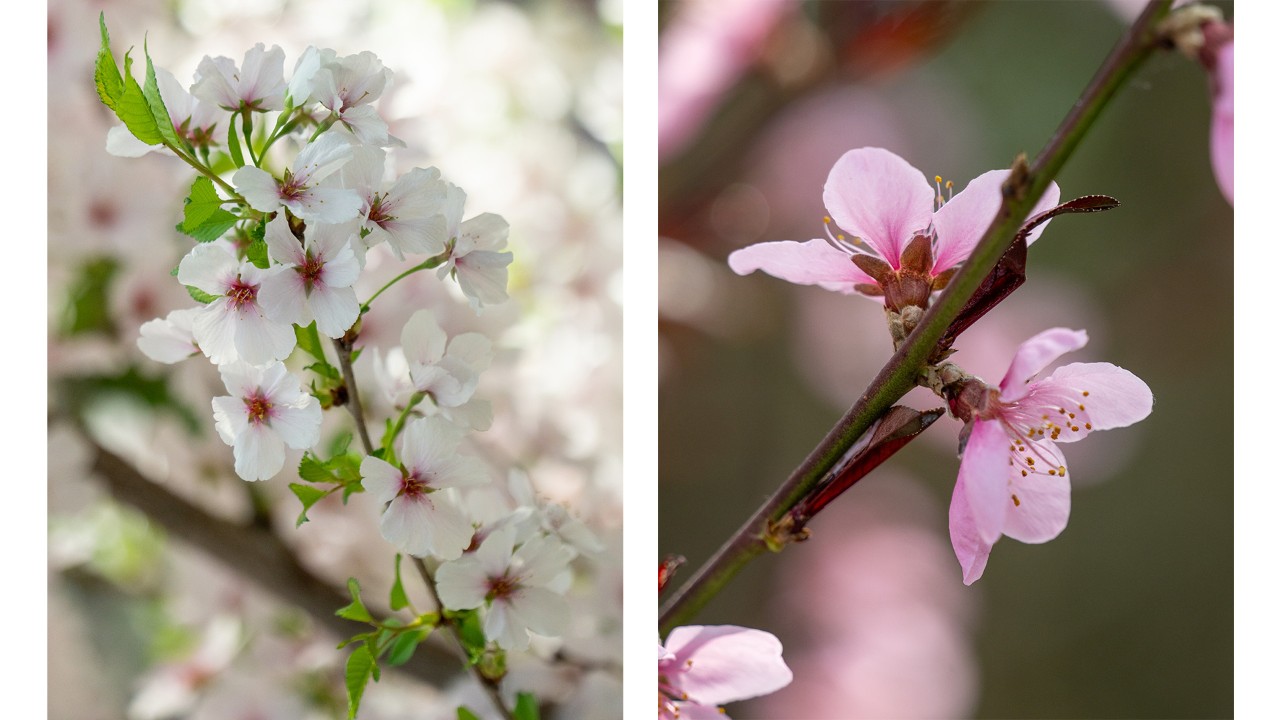 Cherry flowers (left) are borne in flower clusters (inflorescences) with multiple flowers emerging from a single node. Each flower is held on a long, thin flower stalk (pedicle). Peach flowers (right) are usually borne opposite each other in pairs or sometimes singly. They are held close to the branch on very short, thick flower stalks.
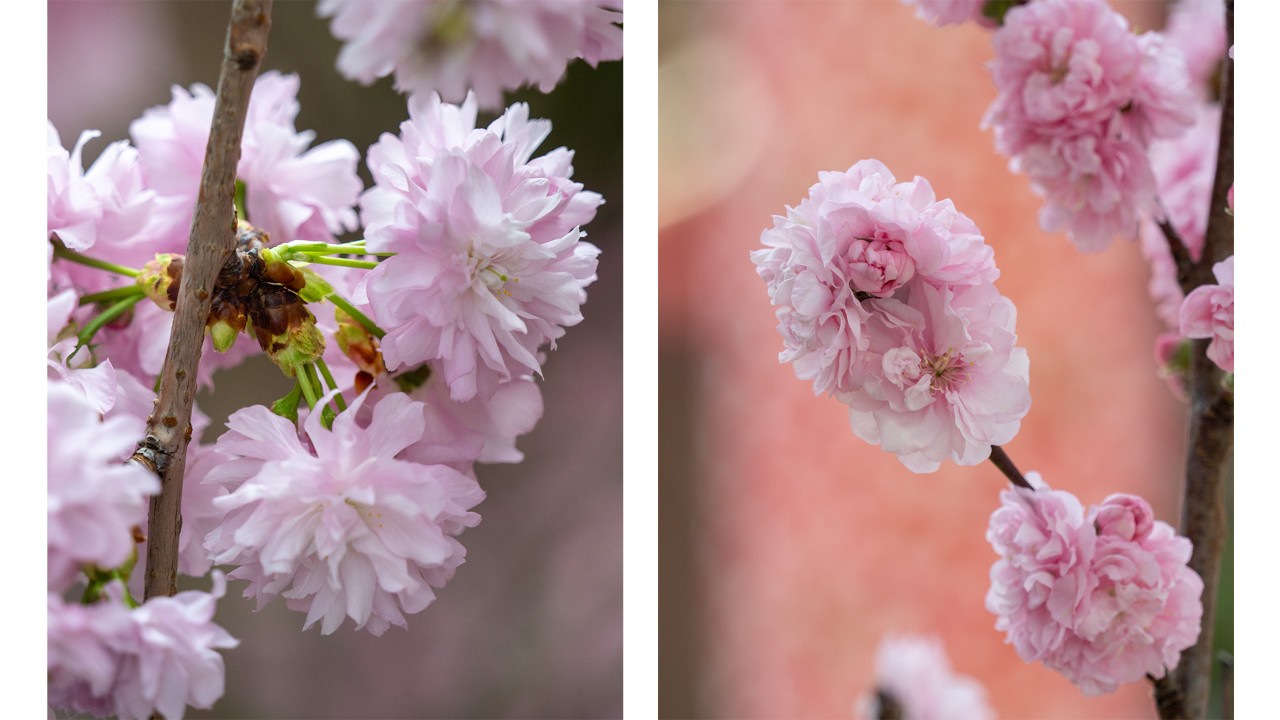 Flowering cherries and flowering peaches also have double-flowered cultivars with much more than their usual five petals! Some chrysanthemum-flowered or kiku-zakura flowering cherries can have as many as 300 petals! Can you tell easily which is cherry and which is peach? Hint: look at the branches and flower stems! The clusters of long, thin flower stems in the left photo indicate a cherry. In the right photo, the flowers held close to the branch on short, thick stems - invisible behind all those petals – are of a peach!
Come down to the Sakura floral display in Flower Dome from now till 15 April and try to spot the difference between these blooming trees!
Written by: Sharifah Osman, Senior Manager (Research and Horticulture)
As an avid flora photographer, Sharifah is consistently curious about the natural world that surrounds her. So much so that she eventually pursued a career in horticulture while dabbling in botanical art and photography during her free time.
This article is part of our What's Blooming series.
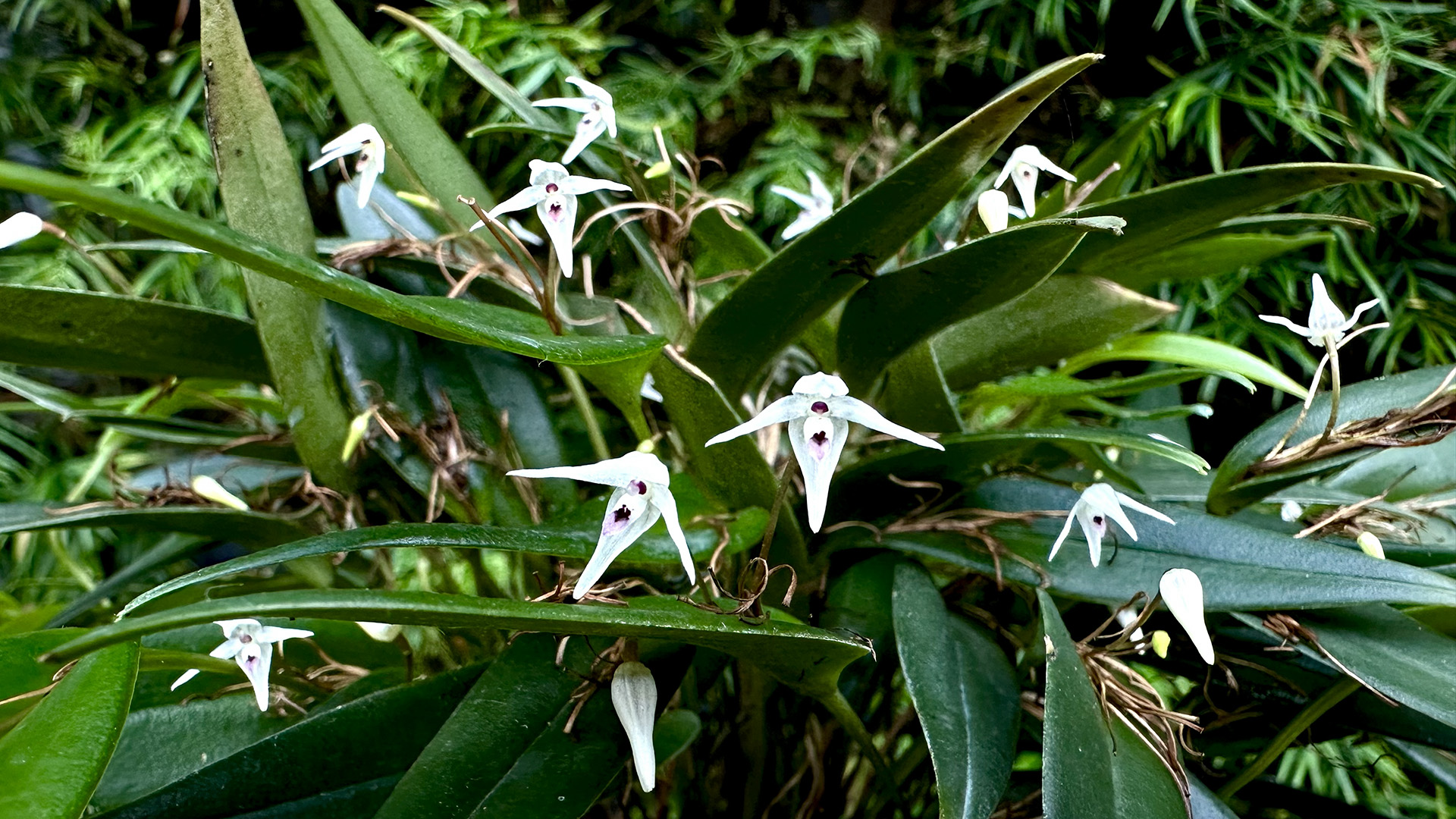
Read Next: The Long-Stemmed Pleurothallis (Pleurothallis eumecocaulon)
The flowers of this orchid are so tiny that you'd better see it through the magnifying glass!
You may also be
interested in
 Back To Top