 Advisory for use of tripods at Disney Garden of Wonder at Floral Fantasy
For a better visiting experience and facilitate crowd movement, we seek your kind understanding that usage of tripods and camera stands will not be permitted in Floral Fantasy.
Bay South–Bay East Bridge Construction from 4 May 2026
To facilitate the construction of the bridge linking Bay South Garden and Bay East Garden, there will be no access for cyclists along the Waterfront Promenade from 4 May 2026. During the construction of the bridge, cyclists heading towards Marina Barrage are advised to take an alternative route around the perimeter of Bay South Garden. Pedestrians may still access the Waterfront Promenade, with a slight diversion to their route.
Click here to download the diversion map.

{{ suggestion.item }}
{{ noOfResults }} results found for "{{ submittedQuery }}"
Filter by
({{ currentFilters.length }})

Showing {{ searchResults.length }} out of {{ noOfResults }}
{{ result.category.label }}
We’re sorry. 0 results found for "{{ submittedQuery }}"
Try doing these:
- Check your spelling
- Try more general words
- Try different keywords
The Ball Dendrobium
(Dendrobium glomeratum)
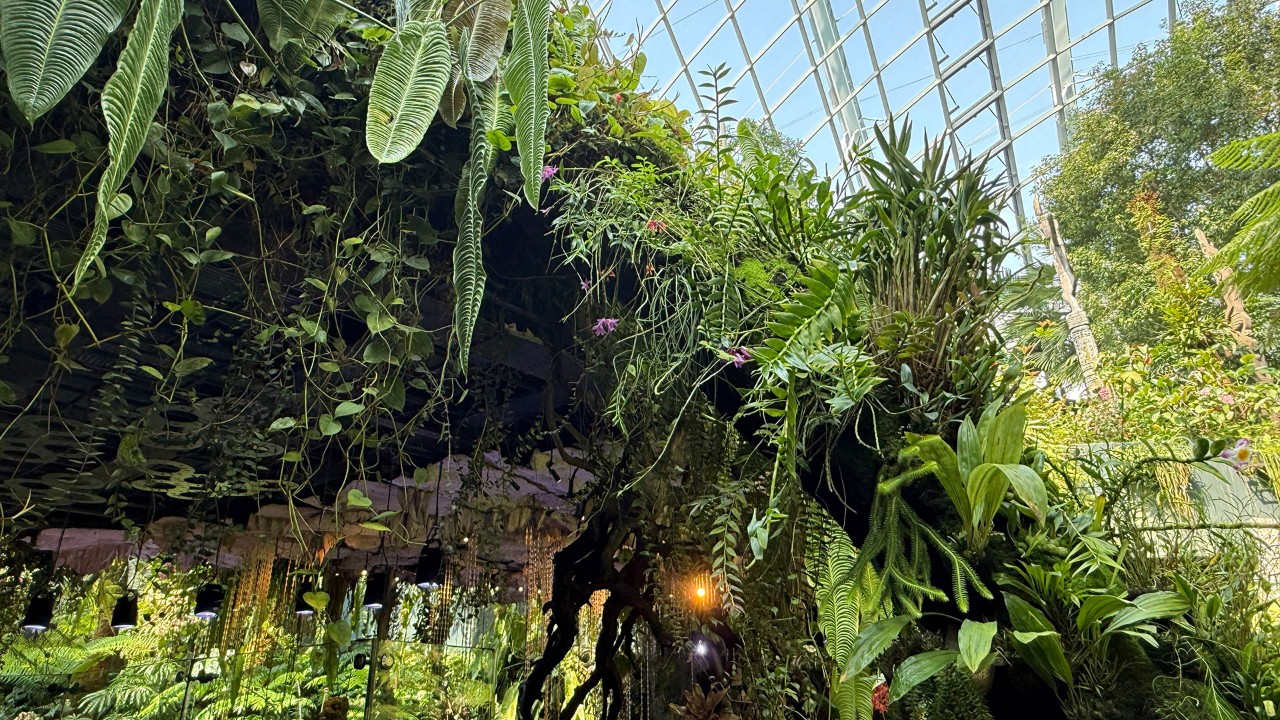 Look closely! Can you spot the clusters of bright pinkish-purple flowers hidden amongst the lush green foliage?
Native to Maluku and Sulawesi, the ball dendrobium (Dendrobium glomeratum) is one of the most spectacular members of Dendrobium section Calyptrochilus. Its striking appearance and long-lasting flowers have made it highly sought after by orchid enthusiasts. Unfortunately, excessive collection from the wild has resulted in significant declines in its natural populations.
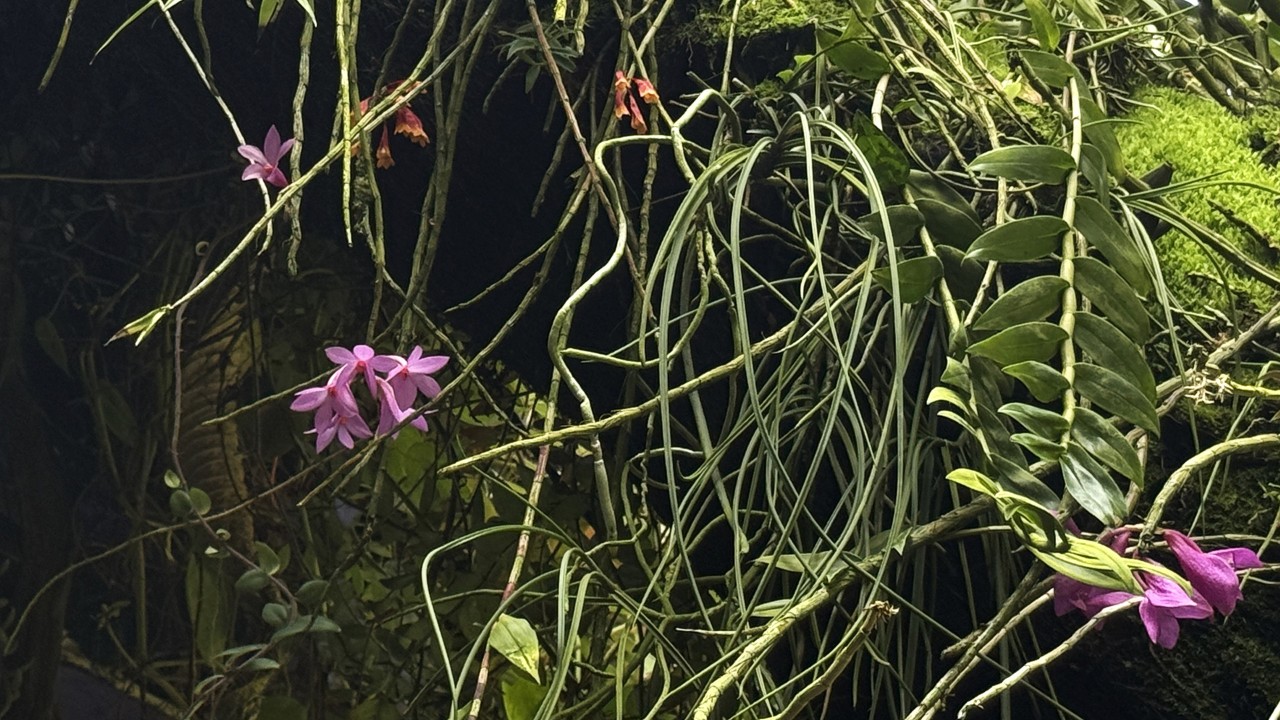 These bare canes of Dendrobium glomeratum are perfectly healthy. After shedding their leaves as part of the plant's natural cycle, they reward us with vibrant clusters of blooms. Sharing the same mount is another member of Dendrobium section Calyptrochilus, Den. lawesii. Smaller in stature, it can be distinguished by its orange and yellow flowers, offering a delightful contrast to the larger, crystalline pinkish-purple blooms of Den. glomeratum.
In the wild, the ball dendrobium grows as a cool-growing epiphyte in old-growth montane forests at elevations of 1,200 metres and above. It produces long, slender, leafy stems that are initially erect but gradually become pendulous with age, making the species particularly well suited for hanging displays. The leaves are deciduous, typically persisting for only one to two years before falling and leaving behind bare canes.
Rather than indicating poor health, these leafless stems are where the plant produces its spectacular floral display, with dense clusters of vividly coloured flowers emerging from the nodes. This deciduous habit is an adaptation to the orchid's natural environment. During cool or dry periods, the plant sheds its leaves to reduce water loss and conserve energy. Before the leaves are shed, valuable nutrients are reabsorbed and stored within the thick, fleshy canes. When favourable conditions return, these nutrient reserves fuel the development of flower buds, transforming the bare stems into a spectacular display of blooms.
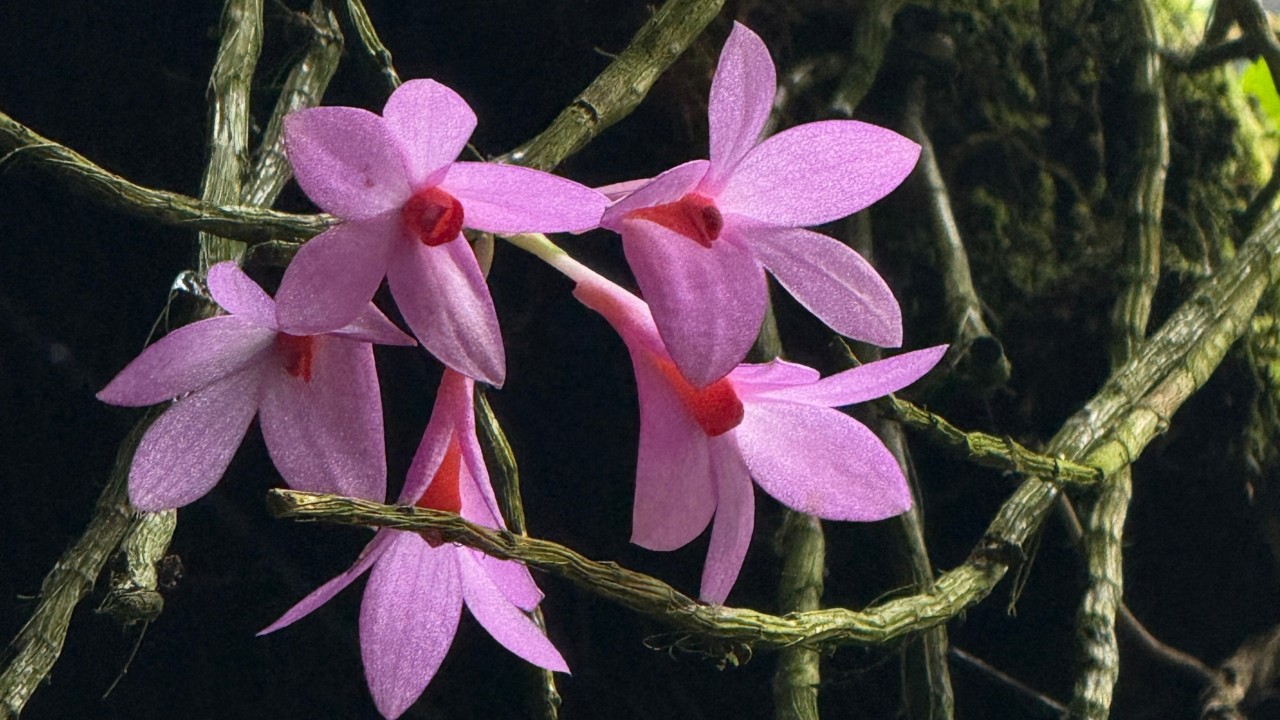 Close-up of the flowers of the ball dendrobium.
Among the members of section Calyptrochilus, Den. glomeratum bears some of the largest flowers, reaching up to 7cm across, more than twice the size of the 1.2 to 2 cm blooms of its close relative, Den. lawesii, which is hanging side by side on the same mount in Cloud Forest. The flowers of Den. glomeratum are especially admired for its dazzling, crystalline pinkish-purple blooms, beautifully contrasted by a vibrant orange lip.
Even more remarkable is their longevity, with each cluster of flowers remaining in bloom for up to a month. The specific epithet glomeratum is derived from the Latin glomeratus, meaning "clustered closely together into a head", a reference to the species' dense, rounded inflorescences. The lip itself is another distinctive feature: its folded apex forms a characteristic boat-shaped structure, adding to the orchid's unique charm and making it instantly recognisable among Dendrobium of other sections.
The brilliantly coloured, nectar-rich flowers may attract nectar-feeding birds, particularly montane honeyeaters (family Meliphagidae), which are thought to act as their pollinators. Supporting this bird-pollination strategy, Den. glomeratum, together with other members of sections Calyptrochilus, bears four naked, bright yellow pollinia arranged in two flattened pairs resembling elongated coffee beans. This distinctive shape is thought to facilitate adhesion to a visiting bird's bill as it probes the nectary spur at the base of the flower to reach the nectar.
On your way out of the Cloud Forest, as you pass through the Secret Garden on the lowest level, don't forget to look up at the arch just before the glass case of the Miniature Orchid Display. You may be rewarded with a view of the dazzling blooms of Dendrobium glomeratum and its companion, Dendrobium lawesii.
Come check out this chartreuse beauty at the Orchid Extravaganza floral display at Flower Dome, from now till 10 August 2026!
Written by: Ziana Yacob, Senior Manager (Research and Horticulture)
Ziana's fascination with the many wonders of plants led her to study Horticulture. She has been involved in propagating and nurturing in-house plant collections, with a special focus on orchids. Keeping plants thriving is both a rewarding challenge and a continuous journey of learning for her!
This article is part of our What's Blooming series.
/Pleurothallis%20niveoglobula_Image_4.jpg)
Read Next: Spherical-White Pleurothallis (Pleurothallis niveoglobula)
The pearl-like flowers of this orchid are so minuscule they are best observed through a magnifying glass!
You may also be
interested in

 Back To Top