 Cancellation of Nature and Sustainability Tours for 10 Oct 2026
Based on the National Environment Agency's 24-hr PSI forecast, air quality is expected to reach Unhealthy range and may extend into the low Very Unhealthy range. As a precautionary measure, all Nature and Sustainability Tours on 10 Oct 2026 will be cancelled.
Closure of Floral Fantasy on 13 Oct 2026
Floral Fantasy will be closed on 13 Oct 2026 for Maintenance.
Advisory for use of tripods at Disney Garden of Wonder at Floral Fantasy
For a better visiting experience and facilitate crowd movement, we seek your kind understanding that usage of tripods and camera stands will not be permitted in Floral Fantasy.
Bay South–Bay East Bridge Construction from 4 May 2026
To facilitate the construction of the bridge linking Bay South Garden and Bay East Garden, there will be no access for cyclists along the Waterfront Promenade from 4 May 2026. During the construction of the bridge, cyclists heading towards Marina Barrage are advised to take an alternative route around the perimeter of Bay South Garden. Pedestrians may still access the Waterfront Promenade, with a slight diversion to their route.
Click here to download the diversion map.

{{ suggestion.item }}
{{ noOfResults }} results found for "{{ submittedQuery }}"
Filter by
({{ currentFilters.length }})

Showing {{ searchResults.length }} out of {{ noOfResults }}
{{ result.category.label }}
We’re sorry. 0 results found for "{{ submittedQuery }}"
Try doing these:
- Check your spelling
- Try more general words
- Try different keywords
Strophanthus preussii
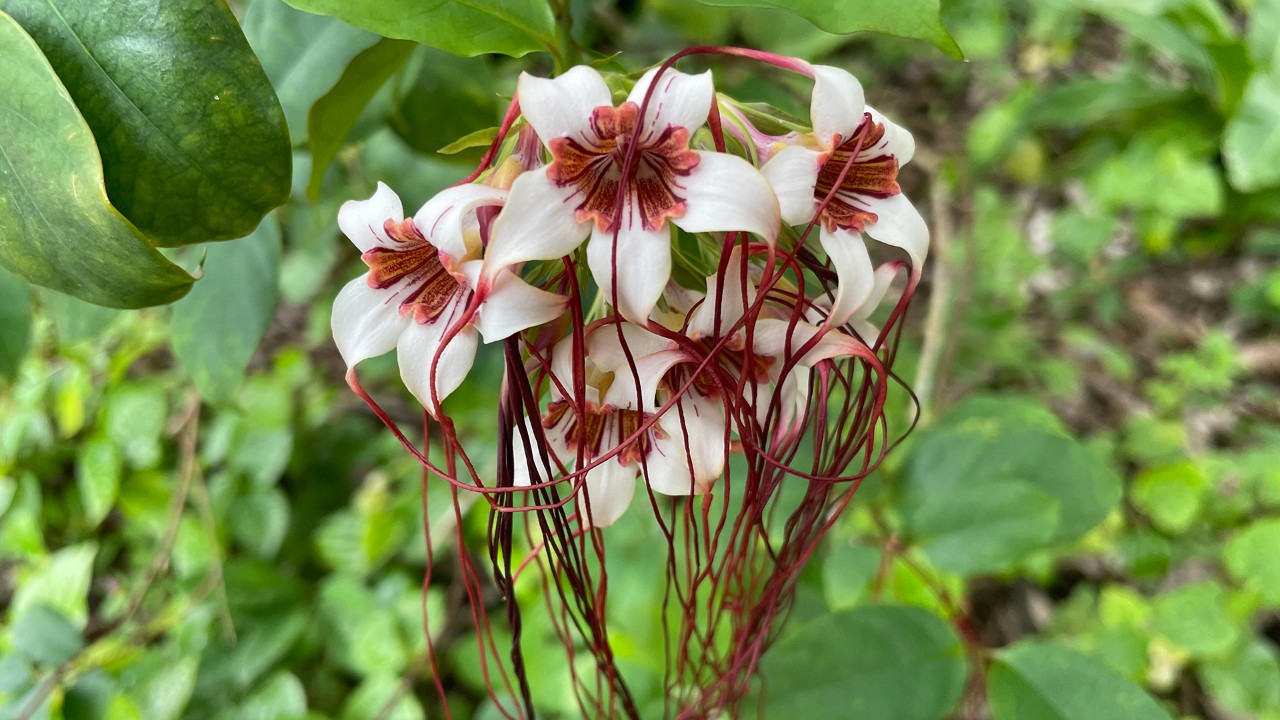
Deep inside the forests of West and Central Africa, this shrubby, evergreen, woody vine holds some heart-stopping secrets! Strophanthus preussii and its 39 other relatives in the same genus have seeds, sap, and roots with variously toxic compounds called cardiac glycosides that can cause heart failure in minutes, if introduced directly into the bloodstream!
Since pre-historic times, various tribes and people have used preparations of sap and pounded seeds, and roots, from members of this genus, often collectively called poison arrow vines, to make poisons to coat spears or arrows with, some of which are used to hunt and bring down animals as large as elephants! These toxins are poorly absorbed by the intestines, making the meat of animals killed by these arrow poisons safe to eat.
The dose makes the poison, and modern medicine is using ouabain - one of the most toxic of these plant compounds - to treat heart failure, low blood pressure, and atypical heart rhythms, and as anti-tumour compounds. Researchers have even discovered humans make and release small quantities of ouabain from the adrenal gland, leading to studies exploring its possible role as a human stress hormone.
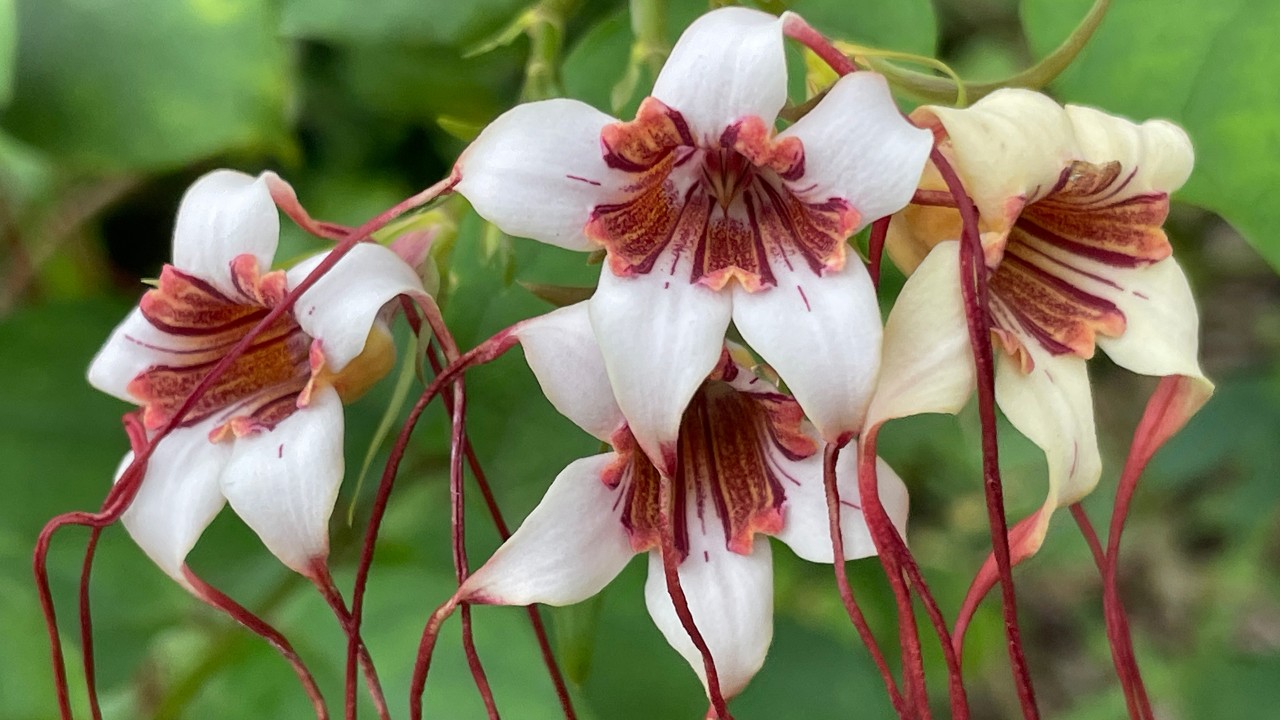 This cluster of four flowers shows three newly-opened white flowers and one older one with corolla lobes changing to pale yellow.
One might also say the flowers of this species are just as heart-stoppingly beautiful, with their colour-changing fused petals (corolla) that starts white and changes to cream, pale orange, or yellow as the flowers age. At the tips of each of the five lobes of these fused petals is a thread-like maroon tendril that can reach up to 30cm in length. The evolutionary purpose of these tendrils is yet a mystery. Perhaps these tendrils act as perches or visually-attractive elements for their equally mysterious pollinators.
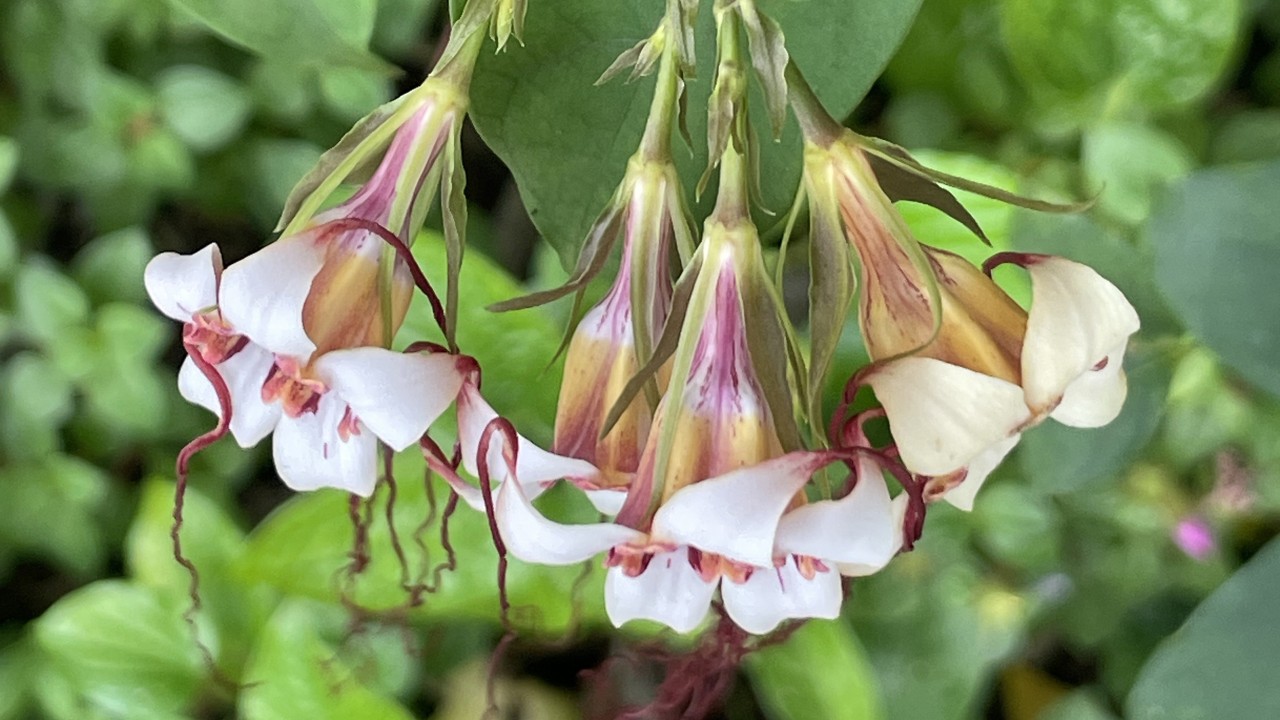 Not only does this plant have extremely long corolla (fused petal) tendrils, but its corolla itself is long and tubular, suggesting its mystery pollinators may be butterflies. Butterflies are known to pollinate other members in the same genus and have long, straw-like mouthparts called probosces that can reach into flowers of this shape, picking up and depositing pollen in the process.
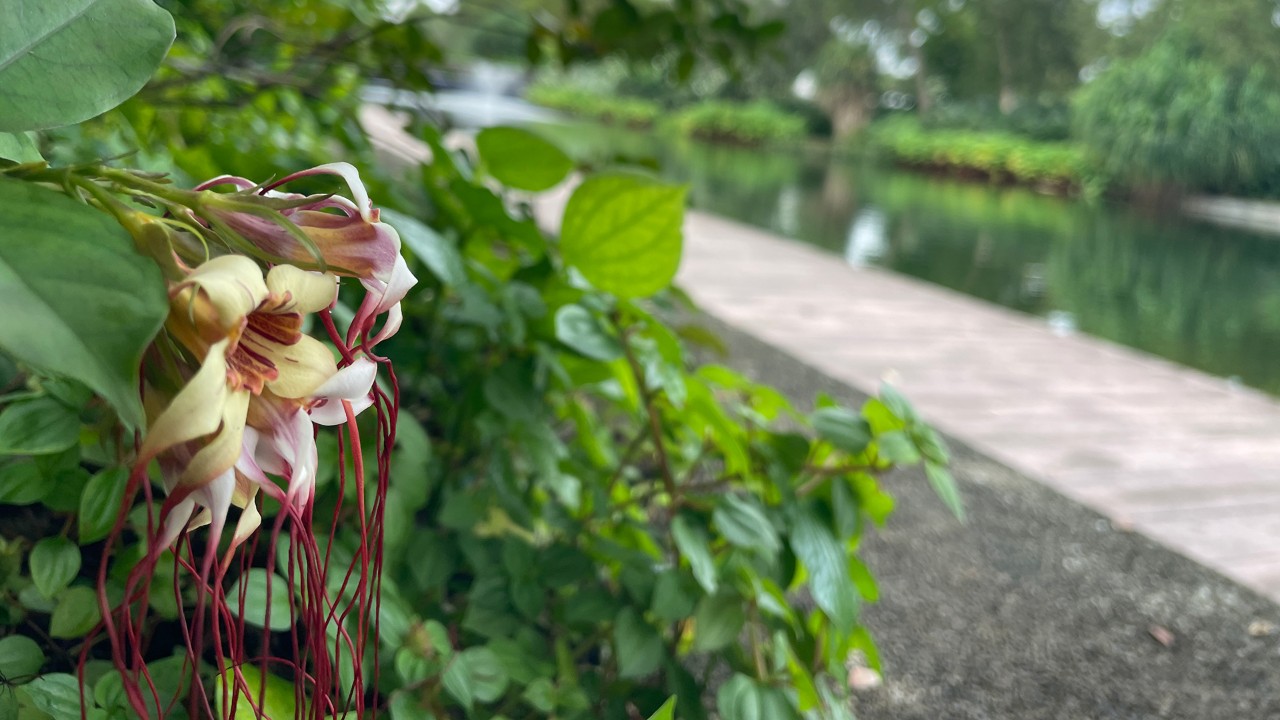
Find these vines and their unique flowers planted along the southwestern boardwalk of Dragonfly Lake, along with other members from the same frangipani family (Apocynaceae), such as the pong pong tree (Cerbera odollam)
Got a free weekend morning to smell the roses? Come on our free, expertly-guided A Sensory Stroll: What’s that Smell? tour and discover the rose allamanda (S. gratus), a rose-scented cousin of this plant, and seven other fascinatingly fragrant plants as part of our Nature and Sustainability Tour series! Go to our tour webpage or Eventbrite to register today!
Written by: Janelle Jung, Senior Researcher (Research and Horticulture)
A transplanted pake (Hawai'i-born Chinese), she's finding her own Singaporean roots. Every plant has a story, and Janelle helps discover and share these with colleagues and guests, hoping to spark a mutual plant passion! Ask her what plant she named her cat after!
This article is part of our What's Blooming series.
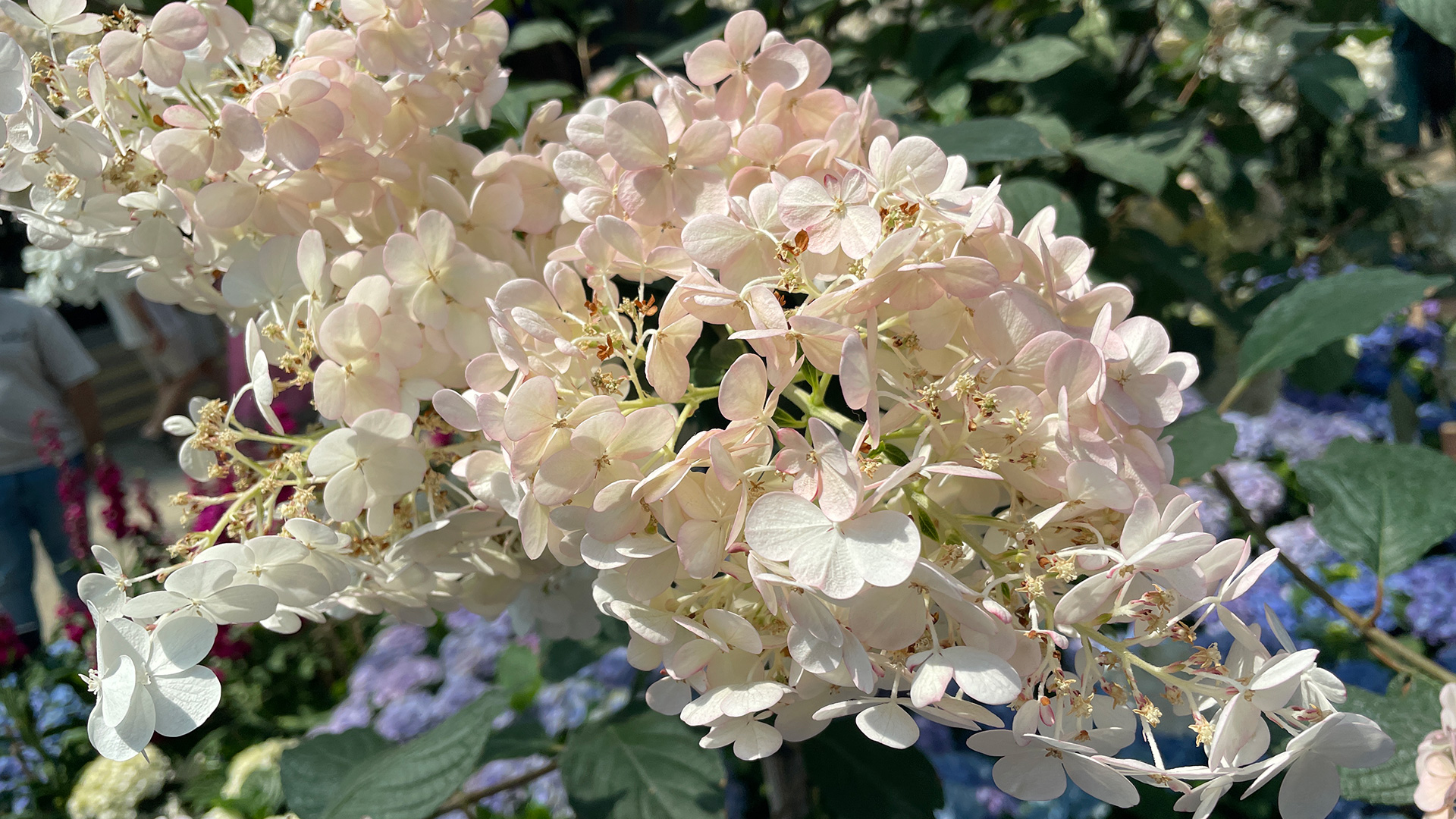
Read Next: Hydrangea paniculata ‘Sundae Fraise’
Have you ever seen ice cream grown on trees before? This hydrangea cultivar features a cream-white to ombre pink shading that looks very much like ice cream on a cone!
You may also be
interested in
 Back To Top