 Closure of Cloud Forest on 26 Oct 2026
Cloud Forest will be closed on 26 Oct 2026 for Maintenance.
Traffic Advisory for Garmin Run Marathon Series 2026 Singapore on Sun, 25 Oct 2026
Please note the following carpark arrangements to facilitate the Garmin Run Marathon Series 2026 Singapore:
- Satay by the Bay Carpark: Closed from 12.01am to 8.00am.
- Main Entrance Basement Carpark: Opens earlier at 3.00am.
- Bayfront Plaza and The Meadow Carparks: Remain accessible throughout the event.
Traffic delays may be expected at the Gardens' carparks due to the Garmin Run Marathon Series 2026 Singapore.
For more details, click here for more details.
Advisory for use of tripods at Disney Garden of Wonder at Floral Fantasy
For a better visiting experience and facilitate crowd movement, we seek your kind understanding that usage of tripods and camera stands will not be permitted in Floral Fantasy.
Bay South–Bay East Bridge Construction from 4 May 2026
To facilitate the construction of the bridge linking Bay South Garden and Bay East Garden, there will be no access for cyclists along the Waterfront Promenade from 4 May 2026. During the construction of the bridge, cyclists heading towards Marina Barrage are advised to take an alternative route around the perimeter of Bay South Garden. Pedestrians may still access the Waterfront Promenade, with a slight diversion to their route.
Click here to download the diversion map.

{{ suggestion.item }}
{{ noOfResults }} results found for "{{ submittedQuery }}"
Filter by
({{ currentFilters.length }})

Showing {{ searchResults.length }} out of {{ noOfResults }}
{{ result.category.label }}
We’re sorry. 0 results found for "{{ submittedQuery }}"
Try doing these:
- Check your spelling
- Try more general words
- Try different keywords
Boat Orchids (Cymbidium cultivars and hybrids)
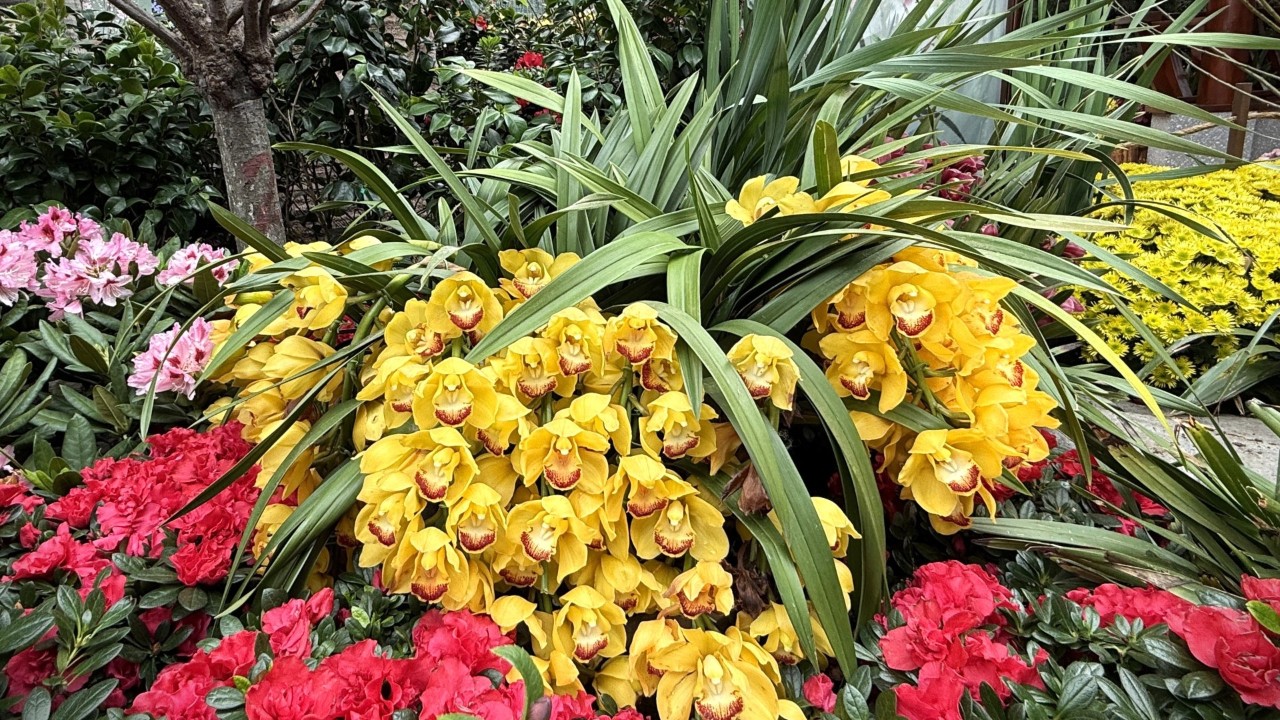 Pendulous Cymbidium inflorescences showcasing a rich display of bright yellow flowers.
Cymbidium is one of the most familiar and widely admired genera in the orchid family (Orchidaceae). Comprising around 90 species, including approximately 15 natural hybrids, these sympodial orchids may grow as epiphytes i.e. living on trees for support without taking nutrients from them. Others are lithophytes, growing on rocks, while some are terrestrial and grow directly in the ground. They are distributed widely across tropical and subtropical Asia to Australia.
Cymbidiums are distinguished by their elongated, strap-like leaves, which emerge in fans from their pseudobulbs and form a refined, arching silhouette. In many species, particularly the Oriental cymbidiums, the foliage itself is highly ornamental, sometimes prized for its variegation as much as for its fragrant flowers.
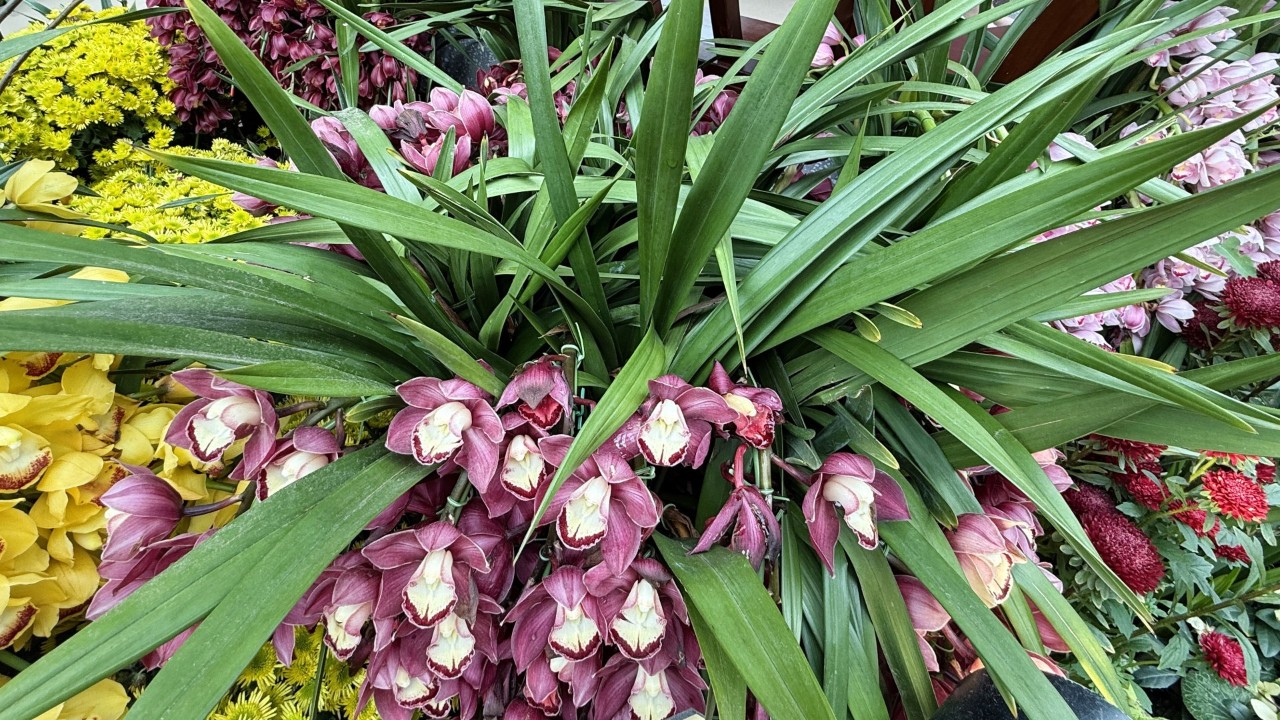 Upright, strap-like leaves emerging in fans from Cymbidium pseudobulbs.
Although their geographic region of origin cannot be determined just by looking at them casually, most modern complex Cymbidium hybrids trace their lineage to cool-growing Asian species, spanning across the Himalayas to Indo-China. With Cymbidium insigne playing a major role in hybridisation, other such species that played a significant role in the development of standard-sized hybrids includes Cymbidium eburneum, Cymbidium hookerianum, Cymbidium sanderae, and Cymbidium erythrostylum. Introduced into cultivation around the 1900s, these species became the foundation of breeding efforts, and within the following two decades numerous hybrids derived from these species were produced.
The exhibited cymbidiums bear flowers measuring approximately 7–10 cm across, a size that makes them especially popular both as potted plants and in the cut-flower trade. Flower spikes may be upright or gracefully pendulous, carrying more than ten blooms on a single inflorescence. The flowers are typically large and showy, displayed in shades of yellow, pink, and red, frequently enhanced by contrasting lips, bold markings, or subtle striping. Their enduring popularity is well-justified by their relative ease of cultivation, broad spectrum of colours, and exceptional floral longevity.
The most distinctive feature is the lip petal, or labellum, which often serves as the focal point of the flower. It is this characteristic lip petal that gives the genus its name Cymbidium, which derived from the Latin word cymba, meaning “boat,” a reference to the distinctive boat-shaped lip petal of some Cymbidium species.
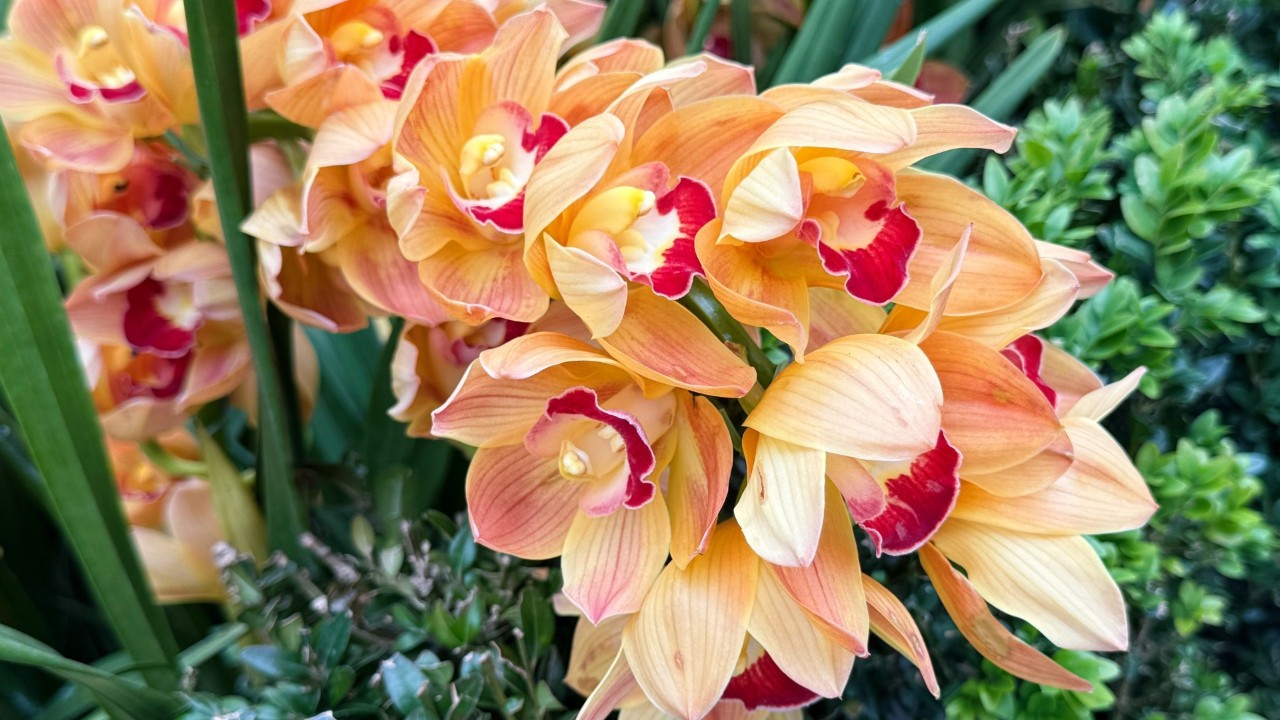 This salmon-coloured Cymbidium hybrid sports contrasting lip petals and subtle striping on both front and back sides of each tepal (identical looking petals and sepals).
Hybrid cymbidiums have existed since the time of Confucius, originating from the smaller-flowered Oriental cymbidium species (section Jensoa) which also form natural hybrids in the wild. These naturally occurring hybrids were readily collected and cultivated, valued not only for their distinctive floral forms but also for their fragrance, with rare hybrid plants also exhibiting beautifully variegated foliage with cream or yellow margins. Today’s modern hybrids display tremendous diversity in colour, form, and size. The inflorescences can remain fresh for eight to ten weeks when kept dry and free from direct water contact, making Cymbidium hybrids among the longest-lasting orchids and comparable to Phalaenopsis hybrids.
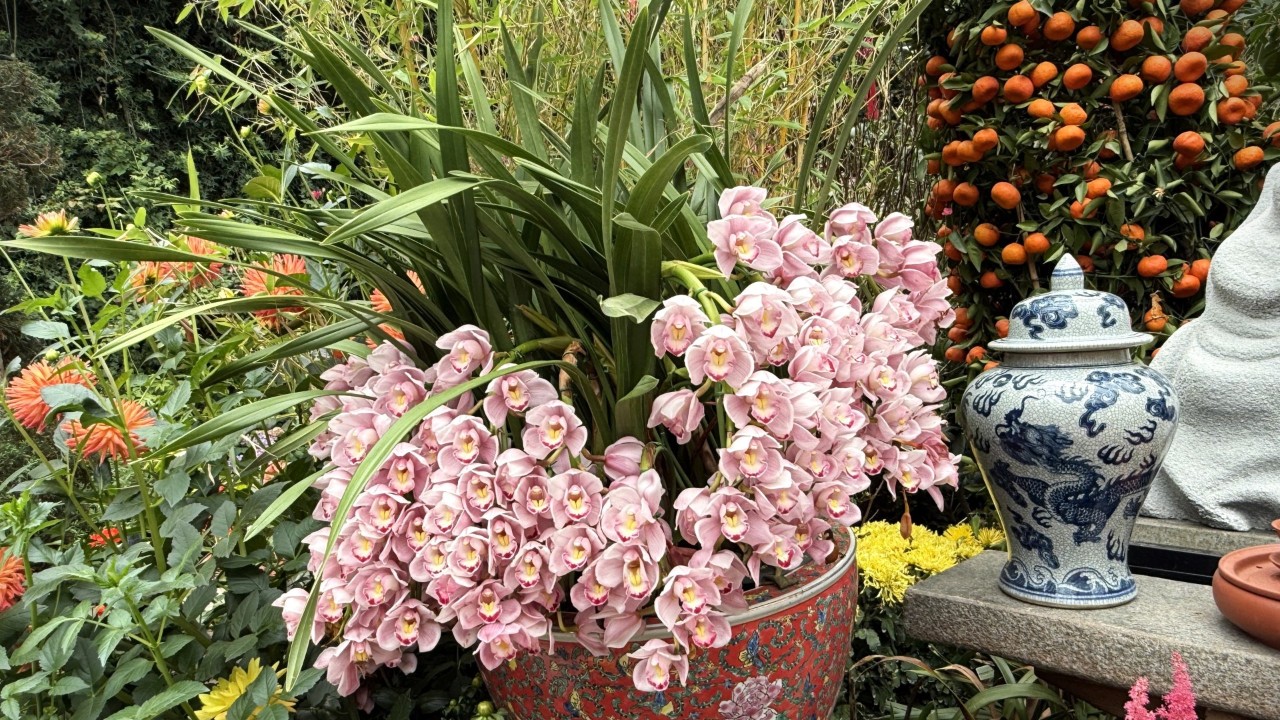 Masses of pink cymbidium flowers spill out of decorative Chinese bowls with floral motifs.
Plum blossoms, orchids, chrysanthemums, and bamboo are collectively known as the ‘Four Gentlemen’ in Chinese art and literati tradition, each symbolising virtues admired in Confucian thought. Among them, the orchid represents refinement, humility, and moral integrity. In China, Cymbidium orchids are far more than botanical specimens; they are enduring cultural symbols. Confucius likened the orchid’s subtle fragrance to the presence of a noble person whose goodness influences others quietly and without self-display, and who remains steadfast in moral principle even in times of hardship. Over centuries, cymbidiums became deeply embedded in Chinese art, poetry, and philosophy, embodying ideals central to the cultivated scholar. Even today, their graceful leaves and understated blooms appear in paintings, ceramics, furniture, and decorative motifs across the Chinese diaspora.
It is for this rich blend of horticultural excellence and cultural symbolism that cymbidium forms an important part of the plant palette for this themed display celebrating the Lunar New Year. Spot these brightly coloured orchids among the plum, bamboo, and chrysanthemum in the Spring Blossoms display at Flower Field in Flower Dome!
Written by: Ziana Yacob, Senior Manager (Research and Horticulture)
Ziana's fascination with the many wonders of plants led her to study Horticulture. She has been involved in propagating and nurturing in-house plant collections, with a special focus on orchids. Keeping plants thriving is both a rewarding challenge and a continuous journey of learning for her!
This article is part of our What's Blooming series.
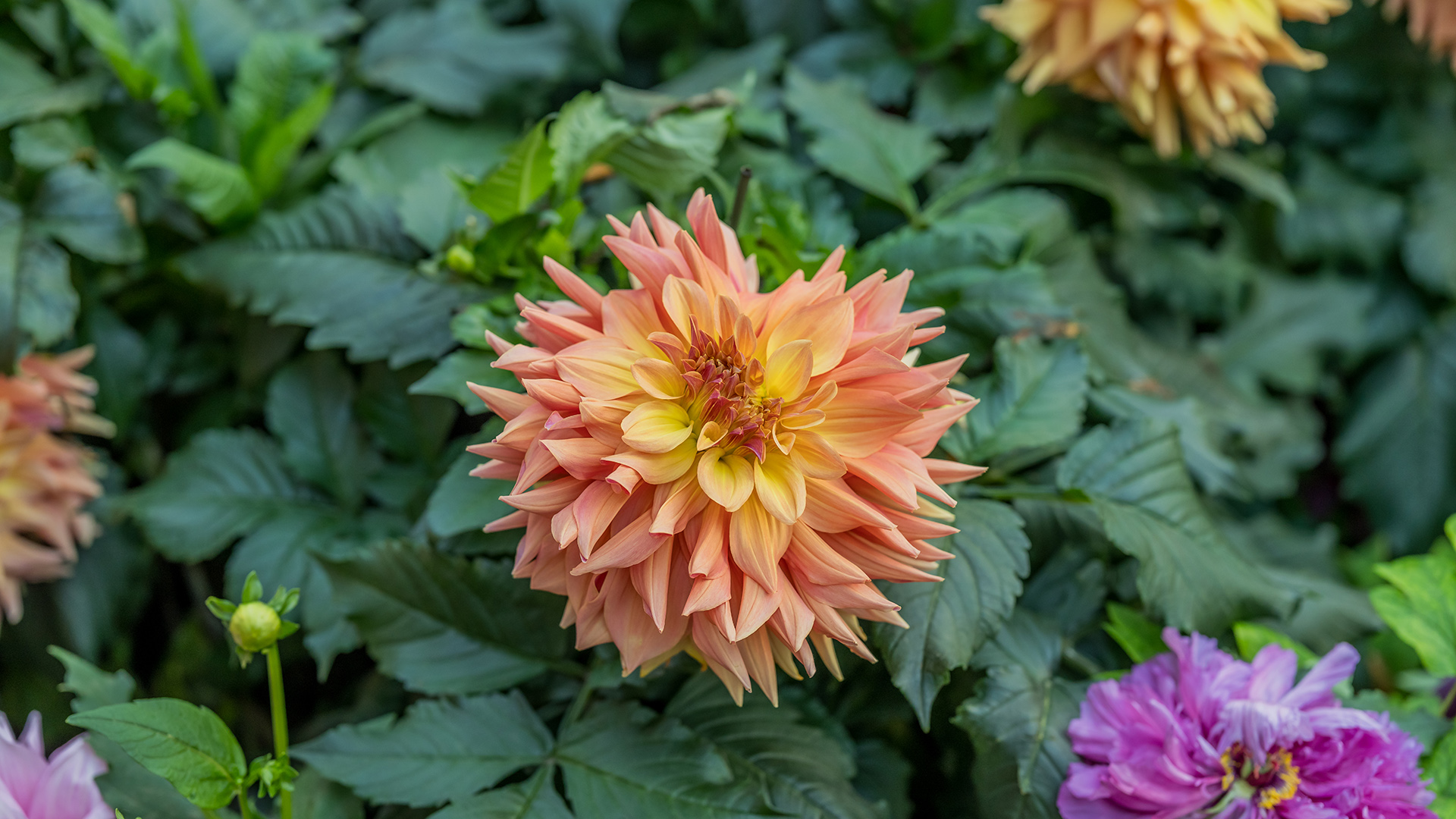
Read Next: Dahlia (Dahlia cultivars and hybrids)
Welcoming the Lunar New Year with its huge blooms over 20cm in diameter, the dinnerplate dahlias are on display!
You may also be
interested in
 Back To Top