 Scheduled maintenance for online ticketing portal on 14 Oct 2026
Closure of Floral Fantasy on 13 Oct 2026
Closure of OCBC Skyway on 14 Oct 2026
Closure of Supertree Observatory on 15 Oct 2026
Advisory for use of tripods at Disney Garden of Wonder at Floral Fantasy
Bay South–Bay East Bridge Construction from 4 May 2026
Scheduled maintenance for online ticketing portal on 14 Oct 2026
Scheduled maintenance for online ticketing portal on 14 Oct 2026
Closure of Floral Fantasy on 13 Oct 2026
Closure of OCBC Skyway on 14 Oct 2026
Closure of Supertree Observatory on 15 Oct 2026
Advisory for use of tripods at Disney Garden of Wonder at Floral Fantasy
Bay South–Bay East Bridge Construction from 4 May 2026
Scheduled maintenance for online ticketing portal on 14 Oct 2026
Our online ticketing portal will undergo maintenance on 14 Oct 2026 from 12.30am to 3.00am. Tickets will not be available for online purchase during this period. We apologise for any inconvenience caused.
Closure of Floral Fantasy on 13 Oct 2026
Floral Fantasy will be closed on 13 Oct 2026 for Maintenance.
Closure of OCBC Skyway on 14 Oct 2026
OCBC Skyway will be closed on 14 Oct 2026 for maintenance.
Closure of Supertree Observatory on 15 Oct 2026
Supertree Observatory will be closed on 15 Oct 2026 for Maintenance.
Advisory for use of tripods at Disney Garden of Wonder at Floral Fantasy
For a better visiting experience and facilitate crowd movement, we seek your kind understanding that usage of tripods and camera stands will not be permitted in Floral Fantasy.
Bay South–Bay East Bridge Construction from 4 May 2026
To facilitate the construction of the bridge linking Bay South Garden and Bay East Garden, there will be no access for cyclists along the Waterfront Promenade from 4 May 2026. During the construction of the bridge, cyclists heading towards Marina Barrage are advised to take an alternative route around the perimeter of Bay South Garden. Pedestrians may still access the Waterfront Promenade, with a slight diversion to their route.
Click here to download the diversion map.

{{ suggestion.item }}
{{ noOfResults }} results found for "{{ submittedQuery }}"
Filter by
({{ currentFilters.length }})

Showing {{ searchResults.length }} out of {{ noOfResults }}
{{ result.category.label }}
We’re sorry. 0 results found for "{{ submittedQuery }}"
Try doing these:
- Check your spelling
- Try more general words
- Try different keywords
Columbian Petunia (Suessenguthia multisetosa)
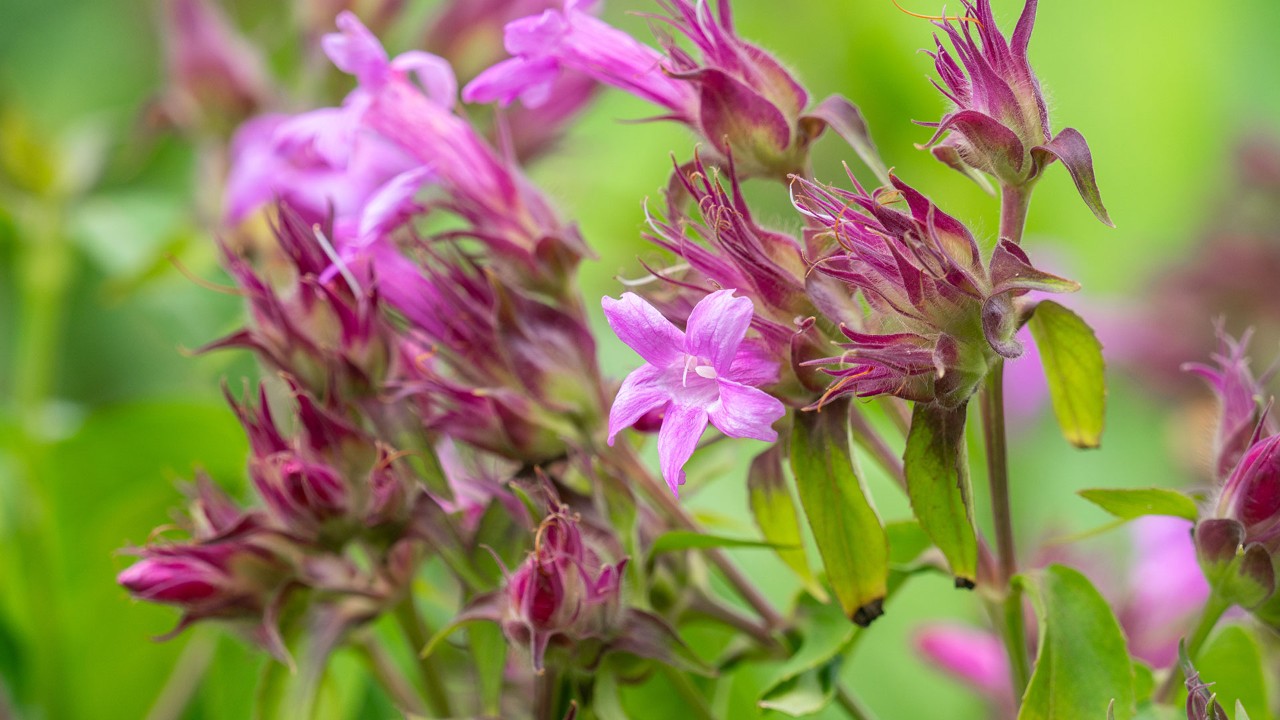
Suessenguthia multisetosa, commonly known as the Columbian petunia, is a striking but little-known member of the Acanthaceae, the same plant family that includes several other South and Central American plants frequently grown as ornamentals in Singapore. These include the purple, pink, or white-flowered Mexican petunia (Ruellia simplex), the red-bracted shrimp plant (Justicia brandegeeana), and the nerve plant (Fittonia albivensis).
The genus Suessenguthia contains eight species found across the Andean foothills and adjacent Amazonia in Bolivia, Peru and western Brazil. The Columbian petunia is endemic solely to Bolivia, where it occurs in the north-central and eastern parts of the country, across the departments (administrative subdivisions) of Beni, La Paz and Santa Cruz. It is found in the Andean foothills, moist tropical forests, and the seasonally dry forests and savannas of Bolivia’s Chiquitania region, generally between about 200 and 700 m elevation.
Depending on growing conditions, the Columbian petunia develops as a large shrub or small tree-like plant about 2–6 m tall. Its young stems can be rather fragile and may require support when cultivated. The opposite, ovate leaves are hairy and measure approximately 15–18 cm long and 5–10 cm wide, with young foliage often emerging dark reddish green before maturing to green.
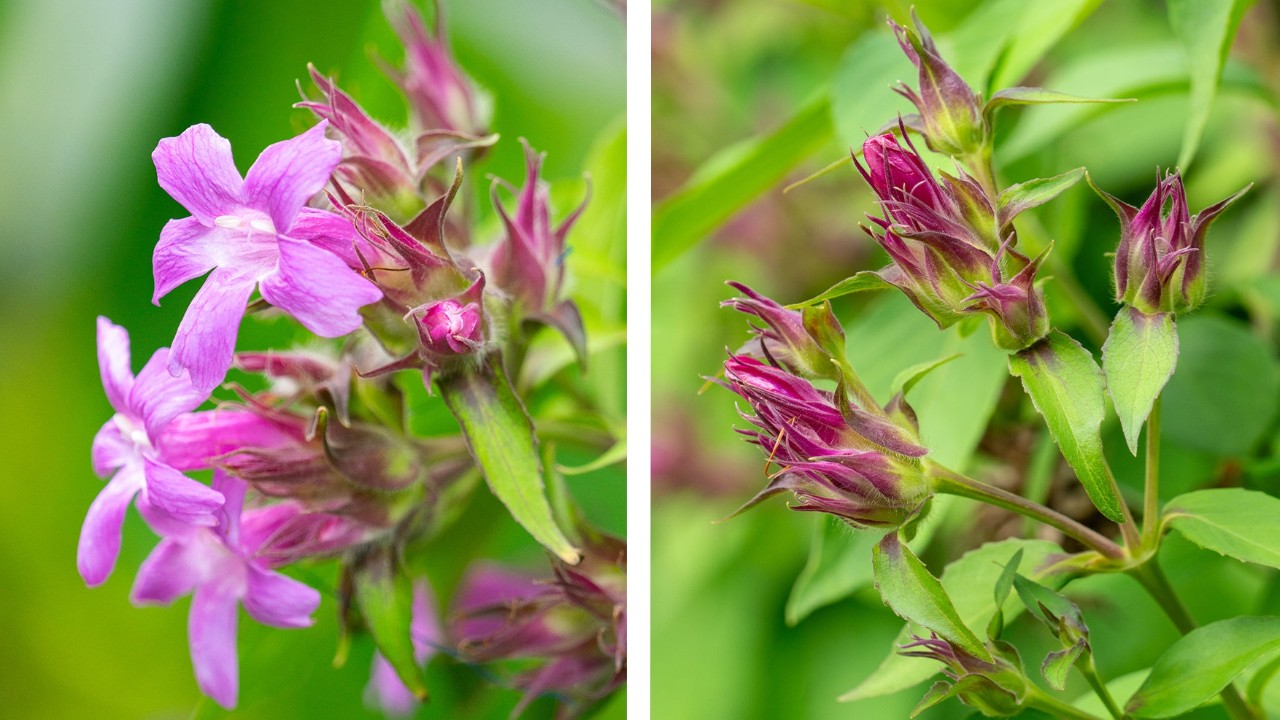 A closer look at the inflorescences of the Columbian petunia. Its vivid purple flowers are surrounded by long, thin bracts covered in downy white hairs, a distinctive feature reflected in its species name multisetosa, meaning “many-bristled”.
The plant is especially noticeable when flowering. Its purple to pink flowers are borne in clusters and can reach approximately 6–8 cm long and 2–4 cm wide. Their broad, tubular form gives them a distinctly petunia-like appearance, despite true petunias belonging to a completely different family, the tomato family (Solanaceae). One of its most distinctive features is highlighted in its species name multisetosa, referring to the multiple hairy, long, narrow and bristle-like, or setose, structures surrounding the flowers, particularly the floral bracts and calyx.
One of the most interesting aspects of the Columbian petunia is its pollination biology. Several species within Suessenguthia have flowers adapted for hummingbird pollination, but the Columbian petunia is bee pollinated. Studies of the genus suggest that an evolutionary shift from bee to hummingbird pollination was accompanied by changes in flower shape and inflorescence structure.
Bee-pollinated flowers tend to be shorter, paler and more funnel-shaped, with broad spreading lobes and stamens held within the corolla, while hummingbird-adapted flowers are generally longer, tubular and more intensely coloured, usually in bird-attracting colours of red, orange, or yellow, with reduced or recurved lobes and protruding stamens. The flowering pattern also shifts from many flowers opening around the same time, supporting intense bee visits over a short period, to fewer flowers opening sequentially over a longer period, supporting hummingbird visits over several weeks to months. Bee pollination is thought to represent the ancestral condition in the genus, with hummingbird pollination evolving later. This makes the Columbian petunia an interesting basal example of the bee-pollinated condition within a group of close relatives adapted to hummingbird pollination.
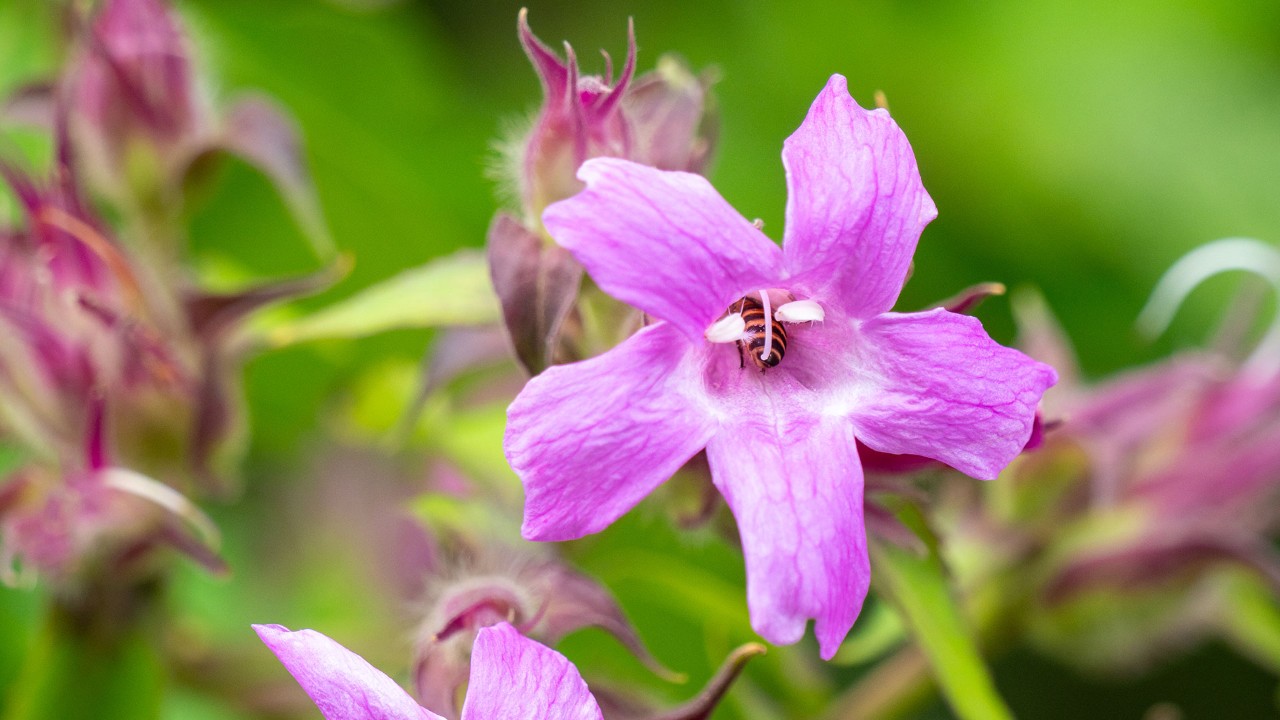 The Columbian petunia is bee-pollinated, unlike several of its close relatives in Suessenguthia that are adapted to hummingbird pollination. Spot the busy bee!
The species is also considered Vulnerable by the IUCN. Although it can be locally abundant in Bolivia’s Chiquitano dry forests, habitat loss and degradation caused by agriculture, cattle ranching, logging, urban expansion and fire threaten parts of its natural range. Its conservation assessment drew upon 63 herbarium specimens collected between 1916 and 2017, providing more than a century of botanical records. Fortunately, populations also occur within protected areas. With its petunia-like blooms, bristly floral structures, unusual pollination story and restricted natural range, the Columbian petunia is far more botanically interesting than its ornamental appearance might first suggest.
Step outside the conservatories and look out for these vivid blooms around Dragonfly Lake, right after the Bayfront shuttle service, where the Columbian petunia can be appreciated up close.
Written by: Sharifah Osman, Senior Manager (Research and Horticulture)
As an avid flora photographer, Sharifah is consistently curious about the natural world that surrounds her. So much so that she eventually pursued a career in horticulture while dabbling in botanical art and photography during her free time.
This article is part of our What's Blooming series.
Read Next: Lilium 'Tiny Massive'
Check out this yellow and black lily that is small but packs a punch, like a bunch of bananas!
You may also be
interested in
 Back To Top